
News |
Quebec City, Canada, hosts 28th
AASP Annual Meeting
Quebec City was the site of the largest-ever AASP Annual Meeting March 1-4, 1997 with:
- 592 veterinarian registrants,
- 32 students,
- 16 officers & board members,
- 135 speakers,
- 11 press,
- nine special guests,
- 108 participants who staffed technical service tables.
President-Elect Dr. Larry Rueff chaired the program committee for this year's meeting, and his opening remarks emphasized the great cooperation he received in organizing all the continuing education and other activities. Dr. Rueff also highlighted his welcome with, "It offers a truly unique opportunity to visit our colleagues in Canada and enjoy the hospitality." The record attendance and enthusiasm of all the attendees confirmed that Quebec City was the "right place" in 1997 for the AASP. This year's theme was "Back to the Basics." The program focused more on disease than it had been in recent years. President Rueff cautioned that pig production is a result of environment, genetics, and management; specifically, this meeting was focused on the aspect that health plays in keeping production online.
Preconvention seminars
The success of preconvention seminars from past years continued with 11 half-day workshop sessions held March 1 and 2. A nutrition workshop featured "Water Management and Growth Modeling." "Offsite Diagnostic Pathology (Wet Lab)" and "Ventilation Evaluation" workshops and offered participants the opportunity to examine fresh necropsies and nursery environments, respectively.
Participants enjoyed two workshop sessions on "Alternative Finishing Concepts and the Practical Economics of Pork Production" and "Cost Control," lead by Dr. Dennis DiPietre. Dr. Bob Morrison coordinated a workshop on "Biotechnology in Swine Production" as it is being applied in the swine industry and what may be on the horizon.
The Sunday morning workshop sessions opened with "Applied Serology and Vaccinology" which dealt with interpretation, selection, and case studies. Another workshop, focused on "Improving Communications and Teamwork," was coordinated by Dr. Morgan Morrow. The final three workshops addressed "PigCHAMP® ProblemSolving," "Swine Reproduction," and "Equipment Decisions."
French veterinarians meet
The preconvention activities included the annual meeting of the Association Francaise de Medecine Veterinaire Porcine (AFMVP) in Quebec City. Over 70 French swine veterinarians came to Quebec, according to AFMVP VicePresident, Dr. Sylvain Blaisot, to share knowledge and open communications. Some mutual concerns including health and drug regulations, animal welfare, and manure management were addressed at the general session on international issues on Tuesday afternoon.
Student presentations and industrial partners
Four simultaneous sessions (one student and three industrial) were held on Sunday afternoon. Students from eight universities made 15 presentations. They represented the University of Illinois, Iowa State University, University of Pennsylvania, University of Guelph, Kansas State University, North Carolina State University, University of Minnesota, and University of Wisconsin. Each student received a $500 honorarium and leather portfolio from Hoffmann-La Roche Animal Nutrition and Health.
The three industrial partner sessions covered 45 presentations which detailed efficacies, applications, procedures, and evaluations of numerous vaccines, drugs, and feed additives. The AASP program committee thanked the many companies for their support by saying, "The contributions of money, time, and resources help the AASP maintain the highest-quality programming at a reasonable cost for our members."
Howard Dunne Memorial Lecture
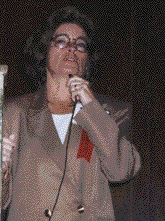
Dr. Barbara Straw of Michigan State University gave the Howard Dunne Memorial Lecture, entitled "Veterinary Practice: Art, Science, and Politics." As Dr. Straw opened her remarks, she said, "Producers are not an easy sell." She continued, "The art of veterinary medicine requires good communication skills, both talking and listening, the ability to read the client, and knowing what will motivate him." Addressing the science of practice, Dr. Straw used cross-fostering of pigs as it relates to age, growth rates, and mortality for her primary example. She pointed out her difficulties in explaining the "science" to the client when highly uniform piglets were weaned even though continuous cross-fostering depressed growth rate of piglets by 20%-25%. Regarding the politics of practice, Dr. Straw stressed that some research activity in the past has been for the sake of publication. She observed, "Now the pendulum is shifting back to a closer relationship between academia and industry." One of her conclusions was, "An organized network of practitioners, diagnostic laboratories, and state and federal regulatory veterinarians that monitor disease trends would help the industry to focus on emerging challenges." She added that it requires a coordinated effort at diagnosis in which investigators share resources and information, within and among institutions. |
Dr. Barbara Straw, 1997 Howard Dunne Memorial Lecturer |
General session speakers
The Annual Meeting theme -- "Back to the Basics" -- was exemplified by ten speakers on Monday as they discussed enteric and respiratory diseases, the related immunology, pathology, and pharmacology, and concluded with economics and the veterinary feed directive.
Dr. Daniel Hurnik spoke on epidemiology of enteric and respiratory diseases, saying that once a population is without disease it becomes susceptible because herd immunity is either not present or declines because births or replacements grow up without exposure. Discussing regional immunity, he pointed out that all farms in a region can be considered a population and therefore the dynamics of transmission apply equally to a geographic region.
In addressing pharmacology, Dr. Scott Brown believes that the pharmaceutical industry will bring more new compounds out for swine in the coming decade than in the previous 25 years. He also believes there will be more water medications, fewer feed medications, more sustainedrelease injectable antibiotics, and other novel methods of administering therapeutic agents.
A practical explanation of native defense mechanisms in the respiratory system as compared to acquired immune defense mechanisms was presented by Dr. James A. Roth. The phagocytic cells, such as neutrophils and alveolar macrophages play a very important role in both native and acquired immunity, according to Dr. Roth, and their function must be present for respiratory defenses.
Dr. Robert DesRosiers chose several common respiratory diseases to review for diagnosis and control. He recommends the following five strategies to prevent respiratory diseases in general:
- carefully select the location of a future farm,
- know what you buy,
- use a strict (complete) all-in-all-out system,
- whenever possible, strictly limit the number of animal sources, and
- raise pigs in comfortable environmental conditions.
Awards
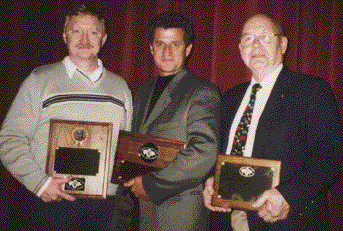
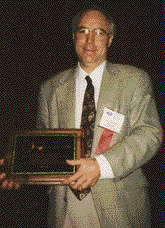
Dr. Tom Neuzil, who is resigning as Executive Secretary of the AASP, was presented with a special award for his service to the AASP by President Howard Hill at the Le Capitole Theater Reception and Banquet. Dr. Gary Dial (Clinton, North Carolina) received the Howard Dunne Memorial Award. He was recognized for his leadership in the AASP, as a Dunne Lecturer, for his many professional presentations, and especially for development of PigCHAMP®. The 1997 Swine PractitioneroftheYear Award recipient was Dr. Neil Shantz, Warman, Saskatchewan, Canada. He was honored for his great service to clients plus his people skills in practicing for swine producers. Dr. David Shoneweis, Manhattan, Kansas, was presented the Meritorious Service Award for his lifetime of work for the AASP. Dr. Shoneweis was specially complimented for his work with students as professor of food animal medicine at Kansas State and Oklahoma State Universities.
|
Above, Dr. Tom Neuzil
Left, Drs. Dial, Schank, and Schoneweis |
Officers
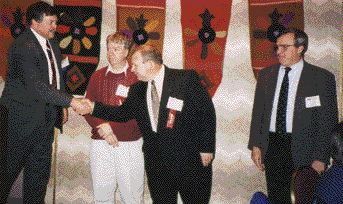
Dr. Larry Rueff, Greensburg, Indiana, was installed as incoming President by Dr. Howard THill at the business luncheon on Tuesday. Dr. Roderick Tubbs, Bowling Green, Kentucky assumed the position of PresidentElect and Dr. Alan B. Scheidt, Raleigh, North Carolina, was installed as the newly elected VicePresident of the AASP. The 1998 AASP annual meeting will be held in Des Moines, Iowa on March 7-10. -- report prepared by Leonard F. Seda, DVM |
AASP Officers Drs. Howard Hill, Larry Rueff, Roderick Tubbs, |
Dr. James Bailey honored in South Dakota
February 15 was proclaimed "Dr. James Bailey Day" by Governor Janklow of South Dakota. Dr. Bailey, a noted swine veterinarian who is now retired, was recognized and presented with awards for his outstanding contributions to veterinary medicine and the swine industry.
The first Dr. James Bailey Lecture was delivered by Avoca, Iowa veterinarian, Dr. Roy Schultz, to veterinarians at South Dakota State on Saturday, February 15, on "The Changing Global Swine Industry."
Dr. Bailey was born and grew up in Atlantic, Iowa. His distinguished
career started upon graduation from the College of Veterinary Medicine (CVM)at
Iowa State College of Science and Technology in 1946. He conducted a general
veterinary practice with his father from
1946-1956 in Atlantic, Iowa. From 1956-1958, he was an ambulatory clinician
in the CVM of Iowa State University (ISU). In 1958, he joined Walnut Grove
Feeds as a field veterinarian. He served as a resource for 450 sales people
in eight states until 1968.
Dr. Bailey joined the South Dakota State University (SDSU) faculty in 1968 as an extension veterinarian, and retired from SDSU in 1985. He was granted the status of Extension Veterinarian Emeritus. He served as the South Dakota Veterinary Medical Association (SDVMA) Secretary/Treasurer from 1972-1985 and was the Executive Director of the SDVMA from 1985-1996.
In 1969, Dr. Bailey was one of the original Extension personnel to compile the fact sheets that became the present Pork Industry Handbook. He contributed information on respiratory diseases and arthritis in swine. He was honored by the American Association of Extension Veterinarians as the Veterinarian of the Year and SDVMA Veterinarian of the Year.
Dr. Bailey served on the South Dakota Hog Cholera and Pseudorabies Eradication committees. He was a member of the South Dakota Livestock Foundation from 1970-1996. He served on the Livestock Conservation Institute's Parasite Committee from 1979-1981. Dr. Bailey received the South Dakota Pork Producers Council (SDPPC) Distinguished Service Award in 1976 and was named an Honorary Pork Producer.
Dr. Bailey served as a member of the American Veterinary Medical Association's House of Delegates through the 1970s and on the Council on Biologics and Therapeutic Agents during the 1980s. Iowa State University CVM presented Dr. Bailey with the prestigious Stange Memorial Award for distinguished alumni in 1984.
Dr. Bailey was a charter member of the AASP in 1969. He served as the organization's first Secretary in 1972 and as the President in 1980-1981. He was granted the distinguished Howard Dunne Memorial Award for extraordinary service to veterinary medicine and the swine industry in 1986.
--Roy Schultz, DVM
Avoca, Iowa