
President's Message
Share your story
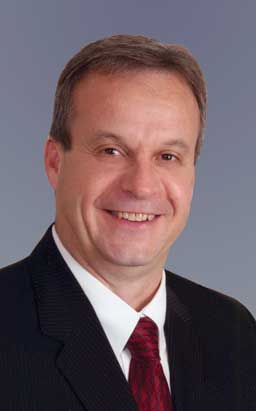
Kerry Keffaber, DVM
Airplane interaction is what I call it. For you it might be labeled your elevator minute message or some other descriptive term. Locations include a hotel lobby, the little league game, church social, or waiting area of a local restaurant. For me, sitting beside someone waiting to take off in an airplane is the most classic. The seatbelts are fastened, the attendant’s instructions have been given, and the person next to me asks where I am headed and what do I “do.” My response, that I am a veterinarian, triggers an avalanche of talk about their “Fluffy” or “Fifi” and an instant connection.
This could continue the entire flight, but usually the question of whether I practice on both cats and dogs and horses soon follows. When I answer that I work only with pigs, the body language changes, as I try to expand the message that veterinarians like me help farmers humanely produce safe, affordable food. Often there is voiced disbelief that a veterinarian works only with pigs, occasionally there is opportunity for deeper discussion about how and why, but many times, the flight magazine in the seat back immediately becomes the most interesting reading ever. End of discussion.
Historically, that has been the response. Most people do not really want to know or think about where their food comes from – as long as it is available in the store at a price their budgets can afford. But times have changed. With the weakened economy and rising energy and grocery costs, food is now a topic of interest. News reports of riots and political unrest in the world because of food shortage and price inflation shift paradigms.
I, along with the rest of the converted choir, have always “amen-ed” the stories on how, with innovation, technology, and investment, US agriculture is feeding exponentially more with less. But the story did not resonate in Peoria or Chicago, LA or New York. We now have an expanded listening audience with the media coverage moving from Trent Loos editorials in Feedstuffs to televised congressional inquiries, front-page Times and USA Today newspaper articles, magazine covers, and evening news lead stories. Politicians include agriculture in their stump speeches even outside Iowa, and President Bush mentions the impact of corn costs to pig and chicken farmers in his news conference. The landscape has changed, we have a great story to tell, and now is the time to share it.
The other story we need to share is the financial stress in the pig business. The significance is not news for our members, who feel it vicariously through their clients or directly, as many have ownership in production. Losses of $30 to $50 per head sold for some time, coupled with increases of $20 to $30 per head in inventory costs, has quickly eroded equity, some at 25% to 40% decline every 6 months. Cycles of profitability and losses continue. While this crisis is cost driven, in contrast to the overproduction and price-driven periods of the past, the response, emotions, and outcome are alike.
Rumors will abound, with about 10% accurate and 90% speculative. Discussions of government buyouts (the current Canadian plan) and piglet euthanasia (old National Farmers Organization days) occur. Trying to cut costs to survive will be a focus. When inputs that return value are removed because of cost-cutting needs, the death spiral has begun. Systems and people will exit the business, a few voluntarily. Most will wait until there is no alternative. There is nothing more painful than watching weekly as the financial reserves evaporate, agonizing over whether to put up more land for collateral. Even worse is realizing there are no more reserves to tap and that, unless cash flow reverses, a date can be fixed that marks the end. Survivability takes on a new definition. Those who survive do so more because of greater access to capitol and risk-protection programs than because they excel at pig production. Sometimes growing at the wrong time works against the best pig people. In this cycle, diversification is preferable to specialization. Certain production systems will see this situation as an opportunity to grow. There will be a strong demand for sound veterinary advice. Last week, I visited four veterinary clinics that were planning to hire new associates.
My father-in-law told me 30 years ago that the biggest contributors to profitability in pigs were disease and low profitability. Without disease, production would be too easy and numbers would exceed demand, with low prices. Likewise, periods of low profitability create an adjustment in numbers that leads to strong profits in the future. This still holds true today. There will be pain in the short term, but long-term, there will be better times …. times when we can feel great about providing the world with safe, affordable food and having a financial return to let us continue, which is the true measure of sustainable agriculture.
-- Kerry Keffaber, DVM