
Original research |
Peer reviewed |
Effect of out-of-feed events and diet particle size on pig performance and welfare
Efecto de eventos de falta de alimento y el tamaño de partícula de la dieta en el desempeño y bienestar
Effet d’épisodes de manque de nourriture et de la dimension des particules d’aliment sur les performances et le bien-être de porcs
Michael C. Brumm, MSc, PhD; Sheryl L. Colgan, BS; Kelly J. Bruns, MSc, PhD
MCB, SLC: Department of Animal Science, University of Nebraska-Lincoln, Lincoln, Nebraska. KJB: Department of Animal and Range Science, South Dakota State University, Brookings, South Dakota. Corresponding author: Dr Michael C. Brumm, Brumm Swine Consultancy, Inc, PO Box 2242, North Mankato, MN 56002–2242; Tel: 507-625-5935; Fax: 507-625-5937; E-mail: mbrumm@hickorytech.net.
Cite as: Brumm MC, Colgan SL, Bruns KJ. Effect of out-of-feed events and diet particle size on pig performance and welfare. J Swine Health Prod. 2008;16(2):72–80.
Also available as a PDF.
SummaryObjective: To determine the impact of repeated out-of-feed events on pig performance. Materials and methods: In each of two experiments, out-of-feed events of 20-hour duration were created by closing the feeder delivery devices from noon until 8:00 am the following morning. In Experiment One, the treatments were never or weekly out-of-feed events for a 16-week period, and 1266-micron versus 1019-micron mash feed-particle size. In Experiment Two, the treatments were zero, one, two, or three out-of-feed events on random days every 2-week period in the 16-week study. In each experiment, there were four pens per treatment combination or treatment and 15 pigs per pen. Results: Weekly events resulted in a 68-g per day lower daily gain for the first 8 weeks (growing period; P < .001), and 35-g per day lower gain over the entire trial (P < .01), compared to the never out-of-feed treatment, with no impact on feed conversion (P > .05). Feed conversion was better when feed particle size was 1019 microns versus 1266 microns (P < .01). In Experiment Two, there was a linear decrease in daily gain with increasing numbers of out-of-feed events during the first 8-week period (P < .01), with no impact during the second 8-week period. There was no effect of treatments on feed conversion. Implications: Repeated out-of-feed events have a bigger impact on growing pigs than on finishing pigs, with the impact expressed as lower weight gain with no effect on feed conversion. | ResumenObjetivo: Determinar el impacto de eventos repetidos de falta de alimento en el desempeño de los cerdos. Materiales y métodos: En cada uno de los dos experimentos, se crearon eventos sin alimento al cerrar durante 20 horas el comedero a partir del mediodía y hasta las 8:00 am de la siguiente mañana. En el Experimento Uno, los tratamientos fueron el que no haya habido falta de alimento o que faltara durante un periodo de 16 semanas, y un tamaño de partícula de 1266 contra 1019 micrones en alimento en polvo. En el Experimento Dos, los tratamientos fueron cero, uno, dos, o tres eventos de falta de alimento en días al azar en periodos de dos semanas en un periodo de estudio de 16 semanas. En cada experimento había cuatro corrales por combinación de tratamiento o tratamiento con 15 cerdos por corral. Resultados: Eventos semanales resultaron en 68 g por día menos en ganancia diaria de peso en las primeras 8 semanas (periodo de crecimiento; P < .001), y 35 g por días menos de ganancia en el periodo completo (P < .01), comparado con el tratamiento donde nunca faltó el alimento, sin impacto en la conversión alimenticia (P > .05). La conversión alimenticia fue mejor cuando el tamaño de la partícula fue de 1019 contra 1266 micrones (P < .01). En el Experimento Dos, hubo una disminución linear en la ganancia diaria conforme aumento el número de evento sin alimento durante el primer periodo de 8 semanas (P < .01), sin impacto durante el segundo periodo de 8 semanas. No hubo efecto de tratamiento sobre la conversión. Implicaciones: Eventos repetidos de falta de alimento tuvieron un mayor impacto en cerdos en crecimiento que en cerdos en finalización, el impacto se expresó en una menor ganancia de peso y sin efecto sobre la conversión alimenticia. | ResuméObjectif: Déterminer l’impact d’épisodes répétés de manque de nourriture sur les performances de porcs. Matériels et méthodes: Lors de chacune de deux expériences, des épisodes de manque de nourriture d’une durée de 20 heures ont été causés en fermant les distributeurs de nourriture à partir de midi jusqu’à 8:00 am le lendemain matin. Lors de l’expérience 1, les traitements étaient effectués en aucune occasion ou à chaque semaine pour une période de 16 semaines, et les particules d’aliment avaient des dimensions de 1266 microns versus 1019 microns. Lors de l’expérience 2, les traitements étaient 0, 1, 2, ou 3 épisodes de manque de nourriture lors de jours au hasard à chaque période de 2 semaines pendant la durée de 16 semaines de l’étude. Dans chaque expérience, il y avait quatre parcs par combinaison de traitement ou traitement et 15 porcs par parc. Résultats: Les épisodes hebdomadaires de manque de nourriture ont résulté en une diminution du gain journalier de 68 g pour les 8 premières semaines (période de croissance; P < .001), et une diminution du gain journalier de 35 g pour la durée totale de l’expérience (P < .01), comparativement au traitement sans manque de nourriture, mais étaient sans impact sur la conversion alimentaire (P > .05). La conversion alimentaire était meilleure lorsque les dimensions des particules d’aliment étaient de 1019 microns comparativement à 1266 microns (P < .01). Lors de l’expérience 2, il y avait une diminution linéaire du gain journalier avec l’augmentation du nombre d’épisodes du manque de nourriture durant la période des 8 premières semaines (P < .01), mais aucun impact durant la deuxième période de 8 semaines. Il n’y avait aucun effet des traitements sur la conversion alimentaire. Implications: Des épisodes répétés de manque de nourriture ont un plus gros impact sur les porcs en croissance que sur les porcs en finition, avec cet impact se manifestant par un plus faible gain de poids mais aucun effet sur la conversion alimentaire. |
Keywords: swine, growth,
feed deprivation, particle size
Search the AASV web site
for pages with similar keywords.
Received: August
22, 2007
Accepted: September
20, 2007
There appear to be three major causes for out-of-feed events in grower-finisher facilities: human errors, bridging of feed, and equipment malfunction. Human errors are generally associated with empty bins. This occurs when feed is not ordered, prepared, or delivered in a timely manner. It is likely that human error has increased as an increasing percentage of feed processing is done away from pork-production facilities. The second cause of out-of-feed events is bridging of ground feed in feed storage devices. In this case, issues associated with flowability prevent feed from flowing out of the storage device into the feed delivery system. Producers often refer to this as “rat-holing” of feed in the device. Issues with bridging are generally limited to systems that use meal diets. As particle size decreases and the amount of fat added increases in corn-based diets, the angle of repose (an estimate of likelihood of bridging) increases.1 In the past 10 years, there has been a marked reduction in the average particle size for swine diets, driven by data which suggests a 1.0% to 1.5% improvement in feed conversion efficiency for each 100-micron reduction in particle size between 1000 and 500 microns.2 The current University of Nebraska recommendation is to process complete diets to an average particle size of 650 to 750 microns for all grains except wheat.3 The final cause of out-of-feed events, equipment malfunction, generally increases as facilities age.
The consequences to the pig are the same regardless of the cause of an out-of-feed event. Considerable anecdotal evidence suggests that when pigs are given access to feed following a period of deprivation, an increase in fighting and aggressive behaviors occurs, and it is likely that this will adversely affect the welfare of all pigs within that pen. Irregular availability of feed during two daily 2-hour periods has been used as a stressor in a study examining acute-phase protein levels as biomarkers for evaluation of distress in growing pigs.4 Carlstead5 reported increased competition and aggression for feeding spaces at feeding time when there was an unreliable or no signal of feed delivery. Short-term feed deprivation (24 hours) has been clearly shown to cause ulcers in growing pigs.6 Periodic feed interruptions would likely create a similar effect in pigs fed ad libitum. While most ulcers had been repaired within 28 days in pigs fed a diet with particle size 750 microns, stomach ulceration continued in pigs either remaining on a finely ground diet (550 microns) or continuing to experience weekly feed deprivations.6 Friendship and Deen7 emphasized that due to the tendency of 24- to 48-hour feed withdrawals to cause stomach lesions, caregivers should investigate all possible causes of feed-intake disruptions, as these disruptions lead to an increase in ulceration rates and potentially hinder performance and increase mortalities. Interruptions in feeding such as occur with out-of-feed events may be inciting factors for hemorrhagic bowel syndrome.8 Over-eating, especially after a period of feed deprivation, has been implicated as a cause of porcine intestinal hemorrhage syndrome.9 If pigs miss one or more meals in a 24-hour period, they do not compensate for this missed feed intake by over-consumption when feed does become available.10 It is possible that repeated out-of-feed events impact carcass composition. Daily gain was lower in pigs fed ad libitum and fasted on alternate days than in pigs not fasted, with minimal impact of fasting on feed conversion efficiency.11 However, carcass dressing percentage was lower, in part because visceral mass comprised a higher percentage of weight at slaughter. Additionally, backfat depth was greater in pigs fed on alternate days than in pigs fed once or twice daily.12
The following experiments were designed to examine the impact of repeated out-of-feed events on pig performance, carcass composition, and incidence of tail biting and skin lesions.
Materials and methods
Two studies were conducted using protocols approved by the University of Nebraska-Lincoln Institutional Animal Care and Use Committee. Both experiments were conducted in a fully slatted wean-to-finish facility at the University of Nebraska’s Haskell Agricultural Laboratory located near Concord, Nebraska. The 16 pens in the facility were each equipped with a two-hole wean-to-finish feeder (Farmweld; Teutopolis, Illinois) and a cup drinker. Each pen (2.4 m × 4.3 m) housed 15 pigs at weaning (total 240 pigs; 0.69 m2 per pig). Pen size was not adjusted in the event of pig death or removal.
Study design
On the day of weaning (14 to 21 days of age), the pigs were transported approximately 325 km to the research site. At arrival, they were ear-tagged, individually weighed, and assigned to pens on the basis of arrival weight such that mean weights and within-pen coefficients of variation for weight were similar for all pens.
In Experiment One, the experimental treatments (ie, out-of-feed events and particle size of feed) were initiated 40 days after weaning (Day 0). Only barrows were used, to minimize random out-of-feed events associated with gilts urinating in a feed trough and plugging or fouling a feeder for an unknown length of time. In Experiment Two, treatments (out-of-feed events) were initiated 37 days after weaning (Day 0), using pens of mixed genders.
In both experiments, four pens of pigs were randomly assigned to each treatment or treatment combination. Pigs were individually weighed on alternate Friday mornings on a scale equipped with a load cell and electronic display capable of 0.45-kg increments. Skin lesions, tail biting, and lameness were observed on every weigh day and subjectively scored by two observers working independently and blinded to experimental treatments. The order of pen observation was varied on each occasion to prevent score biases associated with the order of observation. All pigs were scanned by real-time ultrasound for 10th rib backfat 5 cm off the midline and loin-muscle area on weeks 4, 8, 12, and 16 of each experiment.
Pigs were vaccinated for Erysipelothrix rhusiopathiae, Mycoplasma hyopneumoniae, and Lawsonia intracellularis prior to Day 0 in each experiment. All pigs that died were examined by a veterinarian for cause of death.
Out-of-feed events and feed measurements
The out-of-feed events consisted of completely closing the delivery device on each feeder at noon and reopening it at 8:00 am the following morning, resulting in a 20-hour period when no feed was available to the pen. Feed was not removed from the feeder during this closure. Feeders were never closed on Thursday evening on the week pigs were to be weighed, to avoid confounding pig body weight (BW) with out-of-feed events. Height of feed remaining in feeders was measured each day at 8:00 am prior to addition of feed to the feeders. Feeders were calibrated for the relationship between feed height and weight of feed at the beginning of Experiment One so that daily feed disappearance could be estimated. Mean feed disappearance after an out-of-feed event was estimated by feed depth measurements and feed additions for the first 24 hours after feed availability was restored to the pen. Mean feed disappearance for pens having out-of-feed events was expressed as a percentage of the mean feed disappearance for pens that never had out-of-feed events during the same time period. As the pens were fully slatted, no estimates of feed spillage or wastage due to treatments were obtained, and feed disappearance was assumed to equate to feed intake for all treatments.
Daily drinking water disappearance was measured for the entire 16-pen facility using a reconditioned water meter obtained from the Lincoln, Nebraska, Municipal Water Department. Water disappearance was recorded at approximately 8:00 am each day.
Experiment One
The experimental treatments in a 2 × 2 factorial arrangement included never out of feed (Never), out of feed during one 24-hour period weekly (Weekly), and coarse or medium feed particle size (Coarse and Medium, respectively). The day of the week (Monday through Friday) for the out-of-feed event was randomized each week, with the restriction of no Thursday event on the week when pigs were weighed.
All pigs that weighed > 93 kg on day 109 of the experiment were slaughtered at 153 days post weaning at the Tyson Fresh Meats facility at Madison, Nebraska. Pigs were tattooed by pen. Pen average carcass data for backfat depth, loin-muscle depth, and percent lean were provided by Tyson Fresh Meats.
Experiment Two
The experimental treatments were zero (0×), one (1×), two (2×), or three (3×) 20-hour out-of-feed events every 2-week period during the 16-week experiment. The day(s) of each 2-week period when the out-of-feed events began were randomly selected from Monday through Thursday. Random days were restricted for the 2× and 3× treatments so that there was at least 1 day of feed availability between out-of-feed events.
Carcass data were not collected at slaughter (154 and 162 days post weaning), which coincided with a holiday period with potential for slaughter-plant disruptions due to worker absences.
Feed and feeding
At arrival, pigs were offered 0.9 kg per pig of a pelleted diet formulated to contain at least 1.60% lysine, 38.6 mg per kg tiamulin hydrogen fumarate, 440 mg per kg chlortetracycline, and 3000 mg per kg zinc as zinc oxide. All subsequent diets were in meal form. The initial diet was followed by 3.0 kg per pig of a diet containing 1.44% lysine and the same antimicrobials contained in the pelleted diet, then 4.5 kg per pig and 10.9 kg per pig of diets containing 1.37% and 1.31% lysine, respectively, each containing 55 mg per kg carbadox. Following this feed budgeting to approximately 20 kg BW (based on the average weight of all pigs in the facility), diets were switched to the next lysine level in sequence, with lysine levels of 1.15% to 36 kg BW, 0.99% from 36 to 61 kg BW, 0.77% from 61 to 89 kg BW, and 0.62% thereafter. These corn-soybean meal-based diets contained 110 mg tylosin per kg to 36 kg BW and 44 mg tylosin per kg thereafter. Diets during the experimental periods contained 3% added fat to 61 kg BW and 1.5% added fat thereafter.
Feed was delivered in bulk to feed bins and augered into a weigh cart for delivery to individual feeders. Diets were formulated with corn ground in a full-screen hammer mill. Feed samples were collected on alternate Fridays, stored, and submitted for particle-size analysis (Ward Laboratories, Kearney, Nebraska) at the conclusion of each experiment.
Scoring of clinical observations
Lesions were ranked on a scale of 0 to 4: score 0, no fresh lesions observed; score 4, more than 12 lesions < 5 mm in length or more than six lesions > 5 mm in length. Tail biting was ranked using a scale of 0 to 4: score 0, no tail-biting lesions; score 4, large, deep, open wound. Lameness was assessed on a scale of 0 to 2: score 0, no evidence of lameness; score 2, complete inability to bear weight on one or more limbs.
Statistical analysis
Pen was the experimental unit for all observations. Performance results were analyzed by ANOVA using the Proc MIXED routine of SAS (SAS Institute; Cary, North Carolina). Performance was compiled for the 8-week growing period (Day 0 to 52 in Experiment One and Day 0 to 55 in Experiment Two), the 8-week finishing period (Day 53 to 109 in Experiment One and Day 56 to 112 in Experiment Two), and overall. Pig weight was included in the model as a covariate for ultrasound data from both experiments and for carcass data from Experiment One. Skin lesions, tail biting, lameness, death loss, and pig removal were analyzed using the Friedman chi-squared test on ranked pen means. Statistical results were significantly different at P < .05.
Results
Experiment One
The only trends (P < .10) for interactions between feed particle size and out-of-feed events were starting weight and carcass lean percent.The main effects of out-of-feed events and particle size on pig performance are presented in Table 1. During the first 8 weeks of the study (grower phase), pigs that experienced out-of-feed events gained 68 g per day less than pigs that were never out of feed (P < .001), with no effect during the second 8 weeks of the study (finisher phase). As a result of the very large difference in daily gain for the grower phase, average daily gain for the entire grow-finish period was 35 g lower in pigs that experienced a weekly out-of-feed event than in pigs that never experienced an out-of-feed event (P < .01). However, there was no impact of out-of-feed events on the variation in weight within a pen for any period.
Table 1: Effects of out-of-feed events and feed particle size on growth performance in grower-finisher pigs (Experiment One)*
* Pigs (barrows only) were housed in 16 pens (15/pen), with four pens per treatment combination. Treatments were initiated 40 days after weaning (Day 0; pigs weaned at 14-21 days of age) and pigs were observed until Day 109. † Average particle size: coarse = 1266 microns (μm); medium = 1019 μm. ‡ OOF = out-of-feed; Never = never out of feed; Weekly = OOF event occurred for 20 hours on a random day each week, managed by closing the feed delivery device on each feeder. ¶ Growth parameters analyzed by ANOVA. § Pigs were individually weighed every 2 weeks on a scale accurate to 0.45 kg. |
|||||||||||||||||||||||||||||||||||||||||||||||||||||||||||||||||||||||||||||||||||||||||||||||||||||||||||||||||||||||||||||||||||||||||||||||||||||||||||||||||||||||||||||||||||||||||||||||||||||
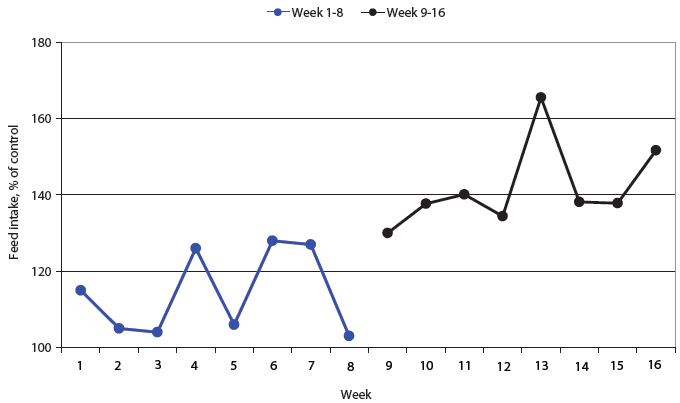
Average daily feed intake for the grower phase of the study was 132 g lower in pens experiencing weekly out-of-feed events (P < .01), but there was no effect of out-of-feed events on feed intake during the finisher phase. Overall, average daily feed intake was 89 g per day lower in pigs experiencing out-of-feed events than in pigs that never experienced out-of-feed events (P < .05). Feed intake for the first 24 hours after feed was made available was numerically lower in the Weekly treatment groups than in the Never treatment group for the first 8 weeks of the experiment (grower period), but not for the finisher period (Figure 1). These data were not included in the statistical analysis, as each data point in the figure was calculated as the value for all Weekly pens expressed as a percentage of all of the Never treatment pens.
| Figure 1: Feed intake for the first 24 hours after
return of feed availability in barrows that experienced weekly out-of-feed
events (Out-of-feed treatment; eight pens, 15 pigs/pen), with intake expressed
as a percentage of that in control pigs that never experienced out-of-feed
events (Never treatment; eight pens, 15 pigs/pen). Pigs were weaned at
14-21 days of age and entered the study 40 days post weaning. Out-of-feed
events were scheduled for a 20-hour period 1 day a week throughout the
8-week grower and 8-week finisher phases of production (Experiment One).
|
There was no effect of out-of-feed treatments on gain:feed for any time period.
When adjusted for the difference in weight due to the out-of-feed events in the Weekly treatment group compared to the Never treatment group, effects of out-of-feed events on 10th rib backfat depth and loin muscle area were minimal. Backfat depth was greater for the Never versus Weekly groups at 12 weeks (P < .05), and loin-muscle area tended to be larger (P < .10) at 16 weeks.
Because of the overall lower daily gain, Weekly pigs weighed less than Never pigs at Day 109 (P < .01), and hot carcass weights were lower (P < .01). There was no effect of out-of-feed events on carcass fat depth, loin-muscle depth, or lean percent at slaughter.
Particle size for the Medium treatment was coarser than expected, even though ground corn was pre-sampled at the commercial mill for both particle sizes with the intent of having coarse (> 1100 microns) and fine (< 850 microns) particle-size diets. The coarse diet averaged 1266 microns (SD, 2.16 microns) and the medium diet averaged 1019 microns (SD, 1.61 microns) for the entire trial. However, for the first 8-week period of the study, the mean particle sizes for the coarse and medium diets were 1224 microns (SD, 2.4 microns) and 929 microns (SD, 1.7 microns), respectively. For the second 8-week period of the study, the mean particle sizes for the coarse and medium diets were 1307 microns (SD, 1.9 microns) and 1109 microns (SD, 1.6 microns).
Particle size had no effect on pig weight, variation in weight within the pen, or daily gain. However, average daily feed intake was significantly lower for the second 8 weeks and overall for the Medium versus the Coarse treatments (Table 1). As a result of the combined lower daily feed intake and similar daily gain in pigs on coarse and medium diets in Experiment One, gain:feed was lower in pigs on the medium diet for both the first and second periods and for the overall 109-day period.
While bridging problems were not quantified, fewer problems with feed removal from the bulk storage bins were noted for the coarse diet versus the medium diet.
There was no difference between treatments for the number of pigs that died, were removed from the study, or weighed < 93 kg on day 109 of the experiment. Two, two, one, and three pigs were removed with three, zero, one, and two pigs dead and two, four, two, and four pigs weighing ≤ 93 kg in the Coarse, Medium, Never, and Weekly treatments, respectively.
Two pigs were removed from the experiment for severe tail-biting injuries: one in the Medium-Weekly treatment combination and the other in the Medium-Never combination.
There was no effect of any experimental treatment on skin-lesion scores (Table 2). There was also no effect of out-of-feed events on tail-biting score; however, tail-biting score was higher in pigs fed the medium diet than in pigs fed the coarse diet (Table 2). While tail biting tended to increase as the experiment progressed, the incidence remained low overall. Lameness was not observed in pigs on any treatment.
Table 2: Effects of out-of-feed events and feed particle size on skin-lesion and tail-biting scores in grower-finisher pigs (Experiment One)*
* Pigs (barrows only) were housed in 16 pens (15/pen), with four pens per treatment combination. Treatments were initiated 40 days after weaning (Day 0; pigs weaned at 14-21 days of age) and pigs were observed until Day 109. † Skin and tail-biting lesions were subjectively scored from 0 to 4 on alternate weeks at the time of individual pig weighing. Skin-lesion score 0, no fresh lesions observed; score 4, > 12 lesions < 5 mm in length or > 6 lesions > 5 mm in length; tail-biting score 0, no tail-biting lesions; score 4, large, deep, open wound. ‡ Average particle size (PS): coarse = 1266 microns (μm) ; medium = 1019 μm. ¶ OOF = out-of-feed; Never = never out of feed; Weekly = OOF event occurred for 20 hours on a random day each week, managed by closing the feed delivery device on each feeder. § Friedman chi-squared test on ranked pen means. |
||||||||||||||||||||||||||||||||||
Experiment Two
Two unplanned out-of-feed events were observed due to gilt urination in the feeder trough. Both events occurred during week 14, with one in a Never out-of-feed pen and the other in a 3× pen on a non-event day.
There was a linear decline in pig weight on Day 56 (P < .05) and in average daily gain (P < .01) for the first 8 weeks of the study with increasing numbers of out-of-feed events (Table 3). There was no effect of out-of-feed events on the variation in pig weight within a pen. Daily feed intake also decreased in a linear manner to day 56 (P < .05). There was no effect of out-of-feed events on feed conversion.
Table 3: Effects of repeated out-of-feed events on pig performance (Experiment Two)*
* Mixed-gender pigs were housed in 16 pens (15/pen), with four pens per treatment. Treatments were initiated 37 days after weaning (Day 0; pigs weaned at 14-21 days of age) and pigs were observed until Day 112. † OOF = out-of-feed; 0× 1×, 2×, and 3× = events scheduled on random days never, once, twice, or three times, respectively, per 2-week period, managed by closing the feed delivery device on each feeder for 20 hours per event. Events were restricted for the 2× and 3× treatments to provide at least 1 day of feed availability between OOF events. ‡ ANOVA. All quadratic and cubic effects P >.10. |
|||||||||||||||||||||||||||||||||||||||||||||||||||||||||||||||||||||||||||||||||||||||||||||||||||||||||||||||||||||||||||||||||||||||||||||||||||||||||||||||||||||||||||||||
For the second 8 weeks of the study, there were no linear, quadratic, or cubic effects of increasing numbers of out-of-feed events on daily gain or daily feed intake. There was a tendency (P < .10) for a linear increase in feed conversion with increasing numbers of out-of-feed events.
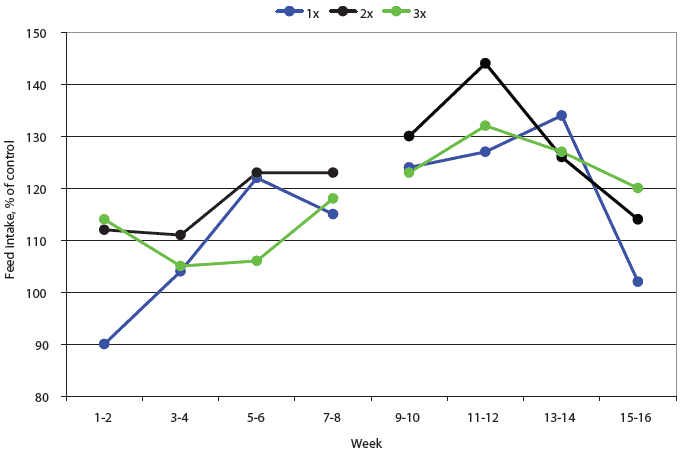
Overall, there was a tendency (P < .10) for a linear decrease in final weight and a linear decrease in daily gain (P < .05) with increasing number of out-of-feed events. There was no overall effect of increasing number of out-of-feed events on daily feed intake or feed conversion. However, feed intake was lower for the out-of-feed treatment groups than for the control treatment group for the first 24 hours after feed was made available during the grower period, but not during the finisher period (Figure 2).
| Figure 2: Feed intake for the first 24 hours after
return of feed availability in mixed-gender pigs that experienced multiple
out-of-feed events per 2-week period, with intake expressed as a percentage
of that in control pigs that never experienced out-of-feed events (Experiment
Two). Pigs were weaned at 14-21 days of age and entered the study 37 days
post weaning. Treatments included one, two, and three 20-hour out-of-feed
events per 2-week period throughout the 8-week grower and 8-week finisher
phases of production (treatments 1×, 2×, and 3×, respectively;
four pens/treatment, 15 pigs/pen). Control pigs (four pens, 15 pigs/pen)
experienced no out-of-feed events.
|
There was a quadratic effect (P < .05) on loin-muscle area at 16 weeks, with the largest loin muscle area recorded for the 3× treatment (38.3 cm2) and the smallest area for the 1× treatment (35.6 cm2). However, there were no effects of out-of-feed events on loin-muscle area at other time points or on fat depth at any time point during the 16-week study.
There was no effect of out-of-feed events on the number of pigs with lesions or the mean lesion score. No lameness was recorded for any pig in this experiment, and the incidence of tail biting was too low to be related to any treatment. One pig died during the experiment. Four pigs were removed from the 2× treatment and two pigs from the 3× treatment.
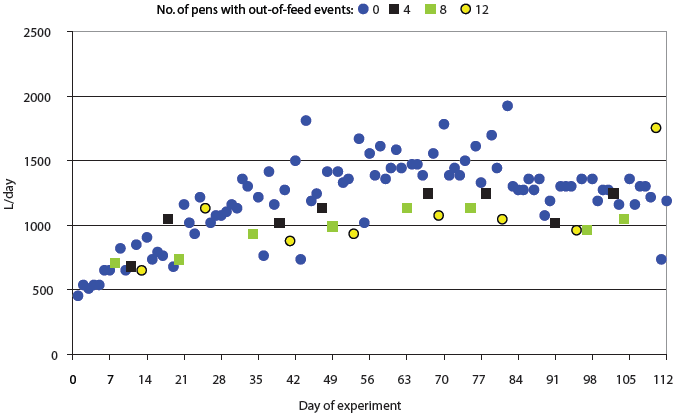
On the days with out-of-feed events, drinking water usage generally declined (Figure 3), but as a single water meter served the entire facility, water usage was not included in the statistical analysis.
| Figure 3: Effect on daily drinking water usage
of the proportion of 16 total pens of finishers experiencing an out-of-feed
event (Experiment Two). Treatments included zero, one, two, and three 20-hour
out-of-feed events during each 2-week period throughout the 8-week grower
and 8-week finisher phases of production (four pens/treatment, 15 pigs/pen).
Water usage was measured once daily with a single meter on the water line
supplying all 16 pens.
|
Discussion
In Experiment One, the 250-micron difference in diet particle size between the Coarse and Medium treatments was associated with a 3.2% difference in feed conversion efficiency, ie, a 1.3% change in feed conversion per 100-micron change in particle size. A similar improvement in feed conversion efficiency (1.0% to 1.5% for each 100-micron reduction in particle size) has been reported by others.2 Particle size was included as a treatment in Experiment One to obtain an estimate of the negative effect on performance if feed bridging is a major cause of out-of-feed events in a production system. One option to reduce the number of out-of-feed events is to deliver to the feed-storage device a diet with a higher mean particle size. The issue for production systems is the interrelationship of potential financial losses associated with lower weight gain caused by out-of-feed events contrasted with poorer feed conversion efficiency caused by higher feed particle size.
These results suggest that the growing pig (20 to 65 kg BW) is more sensitive to out-of-feed events than the finishing pig. The number of out-of-feed events did not appear to influence this response either in Experiment One or Experiment Two, ie, there were no performance differences for the second 8-week period for any out-of-feed treatment, and no difference in feed intake for the out-of-feed pigs versus the control pigs for the first 24 hours after feed availability was restored in the pen. One possible explanation for this difference in growth response to out-of feed events may be associated with genetic selection pressure for improved feed efficiency and decreased fat deposition.13,14 This results in an indirect selection for a limit on ad libitum feed intake, especially as the pig approaches maturity, when the rate of lean deposition decreases and fat deposition potentially increases.15 It may be that during the growing phase (first 8 weeks of these experiments), appetite was controlled in part by the pigs’ genetic predisposition for lean growth. The pigs may have been already ingesting feed at a level approaching the capacity of the digestive system. This would explain why feed disappearance for the first 24-hour period after the return of feed availability was not greatly elevated. During the second 8-week period, as the pigs began the transition from rapid lean gain to a plateau or even a decline in lean gain, with an increase in fat deposition,15 appetite may have been restricted by the pigs’ genetic selection for feed efficiency and decreased fat deposition. When feed became available following an out-of-feed event, the affected finisher pigs could eat more feed than the control pigs, which were not eating at a level that approached the capacity of the digestive system.
It is possible that these results would differ if a different model were used for the timing of the out-of-feed event. Under thermoneutral conditions, growing pigs begin eating at approximately 6:00 am, with a peak in eating activity mid-afternoon and a sharp decline thereafter.16 In these experiments, the out-of-feed event did not begin until noon. It is probable that by noon, most pigs in the out-of-feed pens had consumed one or more meals. In contrast, an out-of-feed event beginning in early morning hours would be much longer, as pigs consume very little feed overnight. This suggests that timing of out-of-feed events may play a role in the production impact of these events.
Kansas State University researchers,17 utilizing the same out-of-feed treatments as in Experiment One, reported no impact of out-of-feed events on performance in an 85-day growing-finishing experiment. Feed intake was not recorded for the first 24 hours after the out-of-feed event, so it is not possible to determine if the response in terms of feed intake was similar to that in Experiments One and Two. Initial weight of the pigs in the Kansas State study averaged 42 kg, versus 24 kg and 18 kg in Experiments One and Two, respectively. It is possible that the higher initial weight in the Kansas study contributed to the lack of performance difference in response to out-of-feed events, further supporting the hypothesis that the growing pig is more susceptible to out-of-feed events.
Drinking-water usage in Experiment Two suggests that during an out-of-feed event, pigs do not attempt to attain gut fill or satiety by consuming extra water. In contrast, greater 24-hour water use was reported in fasted or limit-fed pigs than in pigs with ad libitum access to feed.18 While these authors suggested that pigs drink water in compensation for ingesting feed, this was not evident in Experiment Two.
Implications
- The growing pig is more sensitive than the finishing pig to repeated out-of-feed events.
- The pig does not appear to compensate during the finishing period for declines in gain that occurred during the growing period due to repeated out-of-feed events.
- Repeated 20-hour out-of-feed events appear to impact daily gain with minimal impacts on feed conversion efficiency.
- Under the conditions of this study, there is no measurable long-term impact of out-of-feed events on skin lesions, tail biting, or lameness.
Acknowledgements
This research was supported by the University of Nebraska Agricultural Research Division and the South Dakota State University Agricultural Experiment Station, with further support from the Nebraska Pork Producers Association and National Pork Board.
References
1. Groesbeck CN, Goodband RD, Tokach MD, Dritz SS, Nelssen JL, DeRouchey JM. Particle size, mill type, and added fat influence angle of repose of ground corn. Prof Anim Scientist. 2006;22:120–125.
*2. Goodband RD, Tokach MD, Dritz SS, Nelssen JL. The Kansas Swine Nutrition Guide. Publication S99. Kansas State University Coop Extension, Manhattan, Kansas; 1997.
*3. Reese DE, Thaler RC, Brumm MC, Lewis AJ, Miller PS, Libal GW. Nebraska and South Dakota Swine Nutrition Guide. Nebraska Coop Extension EC95–273, University of Nebraska, Lincoln, Nebraska; 2000.
4. Pineiro C, Pineiro M, Morales J, Carpintero R, Campbell FM, Eckersall PD, Toussaint MJM, Alava MA, Lampreave F. Pig acute-phase protein levels after stress induced by changes in the pattern of food administration. Animal. 2007;1:133–139.
5. Carlstead K. Predictability of feeding: its effect on agonistic behaviour and growth in grower pigs. Appl Anim Behav Sci. 1986;16:25–38.
6. Lawerence BV, Anderson DB, Adeola O, Cline TR. Changes in pars esophageal tissue appearance of the porcine stomach in response to transportation, feed deprivation, and diet composition. J Anim Sci. 1998;76:788–795.
7. Friendship RM, Deen J. Treatment and control of gastric ulcers. Comp Cont Edu Pract Vet. 1997;September:S234-S237.
8. Straw B, Dewey C, Kober J, Henry SC. Factors associated with death due to hemorrhagic bowel syndrome in two large commercial swine farms. J Swine Health Prod. 2002;10:75–79.
9. Buddle JR, Twomey DE. The “porcine intestinal distension syndrome”. Pig J. 2002;50:68–82.
*10. Bird N. Feeding finishing pigs – the importance of regular meal times. Available at: http://www.thepigsite.com/FeaturedArticle/Default.asp?Area=&Display=981. Accessed 9 November, 2007.
11. Veum TL, Pond WG, Van Vleck LD, Walker EF Jr, Kroo LK. Effect of feeding-fasting interval on finishing pigs: weight gain, feed utilization and physical and chemical carcass measurements. J Anim Sci. 1970;30:382–387.
12. van Kempen GJM, Boer H, van der Poel AFB, van Poppel FJJ: Effect of frequency of feeding and dietary treatment on metabolism, performance and carcass characteristics of swine. Neth J Agric Sci. 1979;27:199–210.
13. Tess MW, Bennett GL, Dickerson GE. Simulation of genetic changes in life cycle efficiency of pork production. II. Effects of components on efficiency. J Anim Sci. 1983;56:354–368.
14. Tess MW, Bennett GL, Dickerson GE. Simulation of genetic changes in life cycle efficiency of pork production. III. Effects of management systems and feed prices on importance of genetic components. J Anim Sci. 1983;56:369–379.
15. Lawrence TLJ, Fowler VR. Growth of Farm Animals. New York, New York: CAB International; 1997.
16. deHaer LCM, Merks JWM. Patterns of daily food intake in growing pigs. Anim Prod. 1992;54:95–104.
17. Linneen SK, Dritz SS, Goodband RD, Tokach MD, DeRouchey JM, Nelssen JM: Effects of frequent out-of-feed events on growth performance of nursery and grow-finish pigs. J Anim Sci. 2007;85:2043–2047.
18. Yang TS, Howard B, Macfarlane WV. Effects of food on drinking behaviour of growing pigs. Appl Anim Ethology. 1981;7:259–270.
*Non-refereed references.