
AASV news
CVM working to address shortage of injectable iron dextran
The Center for Veterinary Medicine (CVM) is aware that there is a likelihood of a shortage of the injectable drug, iron dextran, for the prevention and treatment of iron deficiency in baby pigs. The CVM considers iron dextran a medically necessary drug and recognizes that a shortage could result in undue animal suffering and disruption in the swine industry. In order to address and alleviate the inadequate supply, CVM is not objecting to Bimeda Inc of Lehigh, Iowa, temporarily importing and distributing an injectable 200-mg-per-mL iron dextran product in the United States from Bimeda MTC Animal Health Inc of Cambridge, Ontario, Canada, through the end of May 2008 or until an adequate US domestically manufactured supply is available.
The CVM is committed to working with veterinarians to supply animal drugs for legitimate medical needs and will consider and evaluate other requests from other manufacturers of the injectable iron dextran product, as needed.
Please see http://www.fda.gov/cvm/Documents/Bimedaltr.pdf for additional information.
Source: FDA – Center for Veterinary Medicine Press Release, December 3, 2007; http://www.fda.gov/cvm/CVM_Updates/Irondexupdate.htm.
FARAD survives
The Food Animal Residue Avoidance Database (FARAD; http://www.farad.org) received a last-minute infusion of funds to allow them to continue operations for another year.
FARAD is a cooperative effort involving North Carolina State University, the University of California-Davis, and the University of Florida, administered through the USDA’s Cooperative State Research, Education, and Extension Service. Its mission is to maintain a database designed to provide livestock producers, extension specialists, and veterinarians with practical information on how to avoid drug, pesticide, and environmental contaminant residue problems. The database includes:
- Current label information, including withdrawal times, of all drugs approved for use in food-producing animals in the United States and on hundreds of products used in Canada, Europe, and Australia.
- Official tolerances for drug and pesticides in tissues, eggs, and milk.
- Descriptions and sensitivities of rapid screening tests for detecting residues in tissues, eggs, and milk.
- Database with approximately 5000 scientific articles with data on residues, pharmacokinetics, and the fate of chemicals in food animals.
In existence since 1982, FARAD has consistently struggled to secure adequate funding to maintain this unique database and provide access for veterinarians and producers. The AVMA, AASV, and National Pork Producers Council have worked to get congress to permanently fund the project and were successful in getting FARAD included in the 2007 Farm Bill currently being debated. Hopefully, this will result in an ongoing source of funding to support this effort.
The information available through FARAD can be an invaluable resource when using drugs extra-label, to determine extended withdrawal times necessary to comply with the Animal Medicinal Drug Use Clarification Act (AMDUCA; http://www.fda.gov/cvm/amducatoc.htm). Expert-mediated assistance is available by calling FARAD at 1-888-USFARAD or by using the searchable database, FARAD VetGRAM, available online (access requires that you register first through the http://www.farad.org/members/index.html member-services link on the home page).
USDA Veterinary Diagnostic Services user fees increased
The US Department of Agriculture’s Animal and Plant Health Inspection Service (APHIS) has adjusted user fees charged for veterinary diagnostic services. These user fees began increasing incrementally on January 1, 2008. The increases will continue through fiscal year 2012 to reflect the rising cost of providing diagnostic services.
Specifically, APHIS will adjust user fees for the following services:
- Laboratory tests, reagents, and other veterinary diagnostic services performed at the National Veterinary Services Laboratories’ (NVSL) Foreign Animal Disease Diagnostic Laboratory;
- Laboratory tests performed as part of isolation and identification testing at NVSL;
- Laboratory tests performed as part of serology testing at NVSL;
- Laboratory tests performed at the pathobiology laboratory at NVSL;
- Diagnostic reagents produced at NVSL or other authorized sites; and
- Other diagnostic services or materials provided at NVSL.
In addition to the role veterinary diagnostic services play in protecting American agriculture, they enhance livestock production, trade, and research. The new schedule of fee increases will help ensure that the fees accurately reflect the cost of providing these important services.
A list of diagnostic services and the fees involved is available on the APHIS veterinary services Web site at: http://www.aphis.usda.gov/animal_health/lab_info_services/diagnos_tests.shtml/.
This final rule was published in the December 19th Federal Register and became effective January 18, 2008.
New virus in pigs pops up in Australia
Australian researchers have found a new type of virus that causes high mortality rates in (primarily) piglets. The virus has been detected in the Australian state of New South Wales. Infection with this virus results in inflammation of the heart muscle, which subsequently results in sudden death among piglets. Additionally, more stillborn and mummificated piglets have been observed. Scientists have named the disease “porcine myocarditis syndrome.” According to the research team, this new type of virus belongs to the group of pestiviruses.
Source: PigProgress.net; http://www.pigprogress.net/home/id1602-38003/new_virus_in_pigs_pops_up_in_australia.html.
Methicillin-resistant Staphylococcus aureus, pigs, and people
Recent research publications from Europe and Canada have reported a newly identified methicillin-resistant Staphylococcus aureus (MRSA) bacteria in livestock and people. The non-typeable MRSA (NT-MRSA) joins the previously recognized hospital-acquired and community-acquired MRSA strains identified in Europe.
Groups such as Keep Antibiotics Working are utilizing these studies to support their agenda to eliminate the use of antibiotics in livestock species. They are calling on congress to provide funding and direction to the US Food and Drug Administration and “other relevant agencies” to conduct sampling of US livestock for MRSA. They are also endorsing federal legislation entitled “The Preservation of Antibiotics for Medical Treatment Act” which would phase out the use of antibiotics that are important in human medicine as animal feed additives within 2 years.
Methicillin-resistant S aureus is a bacterium not uncommonly found in the nasal passages and skin of humans, pigs, and many other animals. While this NT-MRSA has been found in pigs, it is not known to cause clinical disease in pigs and has not been associated with any known recent human infections. There is currently no evidence that the recent increase in non-healthcare-setting human MRSA cases is associated with contact with pigs.
Pork Checkoff has recently funded a research proposal to determine if NT-MRSA is present in US swine herds, pork producers, and veterinarians. Non-typeable MRSA is not considered a food-safety concern.
Colorado pork producers announce new animal management procedures
Colorado pork producers announced they will begin to phase in group housing for pregnant sows on their Colorado farms over a 10-year period.
“Although animal-welfare experts and professional groups have found no one method of housing gestating sows that is clearly better than the other, when managed properly, some concerns have been voiced about the use of individual stalls for pregnant sows,” explained Ivan Steinke, executive director of the Colorado Pork Producers Council.
“Individual stalls, the standard practice used in the swine industry, are used to provide for the health, safety and well-being for each gestating sow.”
“To address public concerns and changing market conditions, Colorado’s pork producers will embark on a 10-year phase-in that will allow producers to thoroughly evaluate and determine the best animal-welfare practices for group housing,” said Steinke. “Because individual stalls continue to be the industry standard, producers may need to reconfigure their farms, acquire new equipment, and staff appropriately in order to provide the best animal care with group-housing systems.”
Dr Temple Grandin, an internationally recognized expert on animal handling and behavior and a professor at Colorado State University, also commended the pork producers, noting, “A 10-year phase-in period of group housing will be needed to allow producers to change pig genetics and train management to the new system.”
Dr Bernard E. Rollin, professor of animal sciences at Colorado State University, stated the change as showing “great sensitivity to changing societal ethical concerns about animals.”
More than 90% of the sows in Colorado will be impacted by these animal management changes. Colorado’s pork producers have also been proactive in participating in the National Pork Board’s PQA and PQA Plus certification programs, which emphasize good management practices not only in the welfare of animals, but also in the handling and use of animal-health products. These programs help to make sure that pork is produced in a way that ensures animal well-being.
AASV to survey swine-veterinarian compensation
The AASV is conducting its third survey of swine-veterinarian income and benefits. Active AASV members in the United States and Canada are asked to watch for information regarding the 2008 survey in the AASV e-Letter and to participate using the electronic survey form on the AASV Web site.
Similar surveys were conducted by the AASV in 2002 and 2005. Members have found the resulting salary and benefit summary useful when seeking employment or preparing to hire veterinary professionals in the swine industry. The survey results have also been utilized to inform veterinary students about the career opportunities available in swine medicine.
Members are asked to complete one of two surveys, depending on their employment type. Members engaged in private practice and those who oversee pig health for a production or genetics company should complete the practitioner survey. Members engaged in education, research, technical services, public health, or regulatory work for a university, corporation, or government should complete the survey for public-corporate veterinarians.
Both surveys contain fewer than 20 questions and are easy to complete. In addition to 2007 income and benefits, the surveys request information about education and training, employment type, and hours worked. The surveys do not request personally identifiable information: individual responses are confidential.
The overall results of the salary and compensation review will be published and distributed for use by AASV members and students.
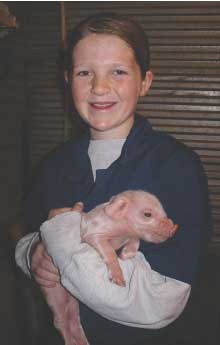
Sage Tokach posing with a newborn piglet
Pigs + photography = Perfect photo for proceedings
When graphic designer Tina Smith started working on the design for this year’s annual meeting program and proceedings book cover, she looked to young photographer Sage Tokach for an image to reflect the meeting theme “Building on our strengths.” Sage did not disappoint when she supplied the cover photo, seen at left depicting a baby pig nestled in a veterinarian’s caring, capable hands.
Sage, the daughter of AASV members Mike and Lisa Tokach, is 11 years old and a sixth grader at Abilene Middle School. She’s in her fourth year in the 4-H photography project, and enjoys taking pictures of animals and nature. She also enjoys going to the pig farm, and especially likes the farrowing house, so this photo was a natural for her. However, it’s not her first published image: Sage’s photo of a sleeping piglet appeared on the back cover of the January-February 2008 issue of the journal.
Sage is a busy young lady, as her interests include horses, taekwondo, volleyball, theater, and band. The AASV is pleased that she finds time to pursue her photography hobby and is willing to share her talent with our members. Thank you, Sage!