
Original research |
Peer reviewed |
Financial and welfare implications of immediately euthanizing compromised nursery pigs
Implicaciones financieras y de bienestar de la eutanasia inmediata de cerdos lastimados en el destete
Les implications du point de vue financier et bien-être animal d'euthanasier immédiatement les porcelets désavantagés en pouponnière
W. E. Morgan Morrow, BVSc, MS, PhD; Robert E. Meyer, DVM, Diplomate ACVA; John Roberts, DVM, PhD; Duncan Lascelles, BVSc, PhD, MRCVS, Diplomate ACVS, ECVS
WEMM: Department of Animal Science, North Carolina State University, Raleigh, North Carolina. REM: Department of Clinical Sciences, College of Veterinary Medicine, Mississippi State University, Mississippi. JR: Department of Population Health and Pathobiology, College of Veterinary Medicine, North Carolina State University, Raleigh, North Carolina. Deceased. DL: Comparative Pain Research Laboratory, Department of Clinical Sciences, College of Veterinary Medicine, North Carolina State University, Raleigh, North Carolina. Corresponding author: Dr W. E. Morgan Morrow, North Carolina State University, 203 Polk Hall, Raleigh, NC 27695-7621; Tel: 919-515-4001; Fax: 919-515-6316; E-mail: morgan_morrow@ncsu.edu.
Cite as: Morrow WEM, Meyer RE, Roberts J, et al. Financial and welfare implications of immediately euthanizing compromised nursery pigs. J Swine Health Prod. 2006;14(1):25-34.
Also available as a PDF.
SummaryObjective: To provide economic and welfare information necessary to determine if a compromised pig should be euthanized or provided continued care. Methods: We assigned batches of pigs to protocols that required many, some, or few compromised pigs to be euthanized upon entering the nursery (aggressive, moderate, or conservative euthanasia protocols, respectively). Compromised pigs not immediately euthanized were ear-tagged and monitored and costs were recorded. Welfare status was assessed daily (higher score indicating worse welfare) and pigs were euthanized as warranted. Compromised pigs were assigned an economic value based on their weight minus costs. Results: A total of 51,041 nursery-age pigs in 47 batches were screened upon entering five farms (herds). The mean value ($US) for pigs by herd ranged from $10.81 to $48.99 for the conservative euthanasia protocol and from $0 to $46.66 for the aggressive protocol. The mean adverse welfare score for pigs by herd ranged from 73.51 to 112.86 for the conservative protocol and from 0 to 59.68 for the aggressive protocol. Implications: Under the conservative euthanasia protocol and the conditions of this study, pigs that are weak, lame, have prolapses, or have two or more concurrent conditions have a low value and high adverse welfare score. Herd welfare can be improved at least cost by immediately euthanizing most of these pigs. | ResumenObjetivo: Proveer la información económica y de bienestar necesaria para determinar si un cerdo lastimado debe ser sacrificado o seguir siendo tratado. Métodos: Asignamos grupos de cerdos a los protocolos que requerían sacrificar muchos, algunos o pocos cerdos al entrar al destete (protocolos de eutanasia agresivos, moderados, o conservadores, respectivamente). A los cerdos lastimados que no fueron sacrificados inmediatamente se les puso un arete para identificación individual, fueron monitoreados y se registraron los costos de los tratamientos. Diariamente, se valoró la condición de bienestar (las puntaciones más altas indican un bienestar más bajo) y los cerdos fueron sacrificados según las indicaciones de bienestar. A cada cerdo lastimado se le asignó un valor económico, basado en su peso menos los costos incurridos. Resultados: Se monitorearon un total de 51,041 cerdos de 47 grupos al entrar al destete de cinco granjas (piaras). El valor promedio ($US) para los cerdos de los diferentes grupos varió de $10.81 a $48.99 para el protocolo de eutanasia conservadora y de $0 a $46.66 para el agresivo. La puntuación promedio de bienestar negativo para los cerdos en las diferentes piaras varió de 73.51 a 112.86 para el protocolo conservador y de 0 a 59.68 para el protocolo agresivo. Implicaciones: Bajo el protocolo de eutanasia conservadora y las condiciones de este estudio, los cerdos débiles, cojos, que tienen prolapso, o que tienen dos o más condiciones simultáneas tienen un valor bajo y una puntuación de bienestar negativo, alta. El bienestar de la piara se puede mejorar a bajo costo al aplicar la eutanasia a la mayoría de estos cerdos. | ResuméObjectif: Fournir l'information nécessaire, du point de vue financier et bien-être animal, pour déterminer si on devrait euthanasier un porcelet désavantagé ou lui fournir des soins continus. Méthodes: Nous avons assigné des groupes de porcelets à des protocoles qui requièrent l'euthanasie de beaucoup, quelques-uns, ou peu de porcelets désavantagés à leur entrée en pouponnière (protocoles d'euthanasie agressifs, modérés, ou conservateurs, respectivement). Les porcelets désavantagés qui n'ont pas été euthanasiés immédiatement ont été identifiés par une étiquette d'oreille et surveillés, et les coûts comptabilisés. Le statut du point de vue bien-être animal a été évalué quotidiennement (un résultat plus élevé indiquant un plus mauvais score de bien-être) et les porcelets ont été euthanasiés selon ce qui était justifié. Une valeur économique basée sur le poids du porcelet moins les coûts a été assignée aux porcelets désavantagés. Résultats: Au total 51,041 porcelets de pouponnière, en 47 groupes, ont été évalués à l'entrée dans cinq fermes (élevages). La valeur moyenne ($ÉU) des porcelets par élevage a varié de $10.81 à $48.99 pour le protocole d'euthanasie conservateur et de $0 à $46.66 pour le protocole agressif. Le score moyen de bien-être des porcelets désavantagés par élevage a varié de 73.51 à 112.86 pour le protocole conservateur et de 0 à 59.68 pour le protocole agressif. Implications: Sous le protocole d'euthanasie conservateur et dans les conditions de cette étude, les porcelets affaiblis, qui boitent, ont un prolapsus ou deux conditions concomitantes, ou plus ont une faible valeur et un score de bien-être élevé (donc mauvais). Le bien-être de l'élevage peut être amélioré à peu de frais en euthanasiant immédiatement la majorité de ces porcelets. |
Keywords: swine, euthanasia,
welfare, economics, injuries, nursery
Search the AASV web site
for pages with similar keywords.
Received: February
11, 2004
Accepted: September
29, 2004
Generally, an animal should be culled when it is no longer profitable or euthanized when it is inhumane to let it live. The difficulty all farm managers encounter is deciding when animals become uneconomic and whether to treat or euthanize the compromised animal. Individual managers usually resort to a very subjective assessment, often heavily weighted by the perceived ability of the animal to return a profit. Focus groups of North Carolina swine producers have told us that having clear criteria for making the decision to euthanize an animal would help reduce some of their job stress. In the companion animal arena, there appears to be much discussion and many suggestions on the appropriate timing of euthanasia.1-4 Many companion animal guidelines are very subjective (eg, ability to enjoy food, ability to breathe freely and without difficulty, ability to eat and drink without pain, ability to respond to owner and family), but when taken together are helpful in creating a euthanasia profile. Other guidelines are more objective, evaluating weight loss, weakness, infection, organ failure, and injuries.5 However, these guidelines may be criticized on the basis that they do not comprehensively evaluate all aspects of welfare.
In farm animals, the approach to euthanasia has been to consider aspects of welfare and economics, although few comprehensive guidelines have been created for swine producers. Some farming systems have adopted specific protocols to help managers decide which animals to euthanize and which to provide with continuing care. For example, the "two-strike" system (John Roberts, North Carolina State University, oral communication, 2003) suggests a weaned pig be euthanized if it fulfills two criteria: it is underweight (eg, < 3.63 kg in a herd in which pigs are weaned at 18 days) and it has a disability, such as a hernia, navel infection, lameness, or poor body condition (compromised pigs). This introduces a special category of concern for pork producers: the lightweight pig. It has been long accepted that lightweight piglets at birth are lightweight at weaning.6 Others have established that pigs lightweight at birth have higher mortality and grow more slowly than normal pigs, and so make a significant contribution to variation in slaughter weight, thus creating a major problem in assembling slaughter loads and a source of financial loss.7 In three-site production, where the system rewards nursery managers for sending more pigs to the finishing barn, there is a tendency to ship too many compromised pigs. Consequently, finishing managers struggle with the issue of how to handle the compromised (underweight or disadvantaged) pigs they receive.
Industry-specific guidelines for euthanasia, such as the National Pork Board guide On-Farm Euthanasia of Swine8 and university-produced extension training materials, such as On-Farm Euthanasia: Better Ways,9 generally agree closely with AVMA-accepted methods and processes. Unfortunately, these guidelines do not help producers decide if and when any individual animal should be euthanized to end its suffering. Suffering may be conceptualized as the product of compromised welfare and its duration. By daily monitoring, farm managers can estimate duration, but the difficulty of deciding what is "compromised welfare" remains. A logical and comprehensive framework for the analysis of welfare of any animal is summarized by the five freedoms:10,11 freedom from hunger and thirst; freedom from physical and thermal discomfort; freedom from pain, injury, and disease; freedom to express normal behavior; freedom from fear and distress. However, to be practically useful, these need to be put into the context of day-to-day production systems, and linked to the financial aspects of production.
In this study, a practical guideline addressing welfare implications of conditions affecting weaned pigs was constructed, using the "five freedoms" approach and incorporating severity, incidence, and duration analysis. The objective of this study was to detail the economic consequences and welfare implications managers need to consider when deciding whether nursery pigs should be euthanized as soon as they are identified or kept and provided care as necessary. Our hypothesis was that pigs with conditions adversely affecting their welfare have relatively low economic value and that prompt euthanasia of these animals would be economical and would improve herd welfare.
Materials and methods
Study herds
The study was conducted in 2002-2003 in five commercial nursery sites (Herds One through Five) owned by four separate entities in North Carolina (a, b, c, and d: two herds were owned by the same entity). Each herd was part of a three-site production system and regularly received nursery-age pigs from its supplier. After growing for about 6 weeks, the pigs were shipped to their respective finishing sites. All five nurseries were curtain-sided and naturally ventilated, with woven wire floors, concrete alleyways, and nipple drinkers, and with similarly sized pens and pig density.
Assigning an adverse welfare score
In order to decide on euthanasia treatment, it was necessary to assign a welfare score to each pig. A list of common conditions requiring treatment in nursery pigs was developed by the authors and the veterinarians of participating farms. A reference notebook was assembled and supplied to each participating farm, with photographs illustrating each condition and level of severity.
To determine the status of welfare associated with each condition (eg, lame, tail bitten, hernia) and its level of severity (ie, A [least severe], B, C, or D [most severe]) an expert panel consisting of three of the investigators and four food-animal veterinarians (including one beef specialist, one swine specialist, and two laboratory animal specialists) was asked to create a welfare score by ranking each level of each monitored condition from 0 to 10 (0, no effect on welfare; 1, little effect on welfare; up to 10, worst possible effect on welfare) (Table 1). In making their rankings, panel participants were asked to consider the five freedoms.10,11
Table 1: Criteria for euthanasia by treatment protocol in a study in five commercial nurseries*
* A panel of three investigators and four food animal veterinarians created the welfare scores by ranking each level of severity (A through D) of each monitored condition from 0 to 10, with 10 the worst possible effect on welfare. † Pigs ear-tagged on entering the nursery were monitored daily for changes in condition. |
|||||||||||||||||||||||||||||||||||||||||||||||||||||||||||||||||||||||||||||||||||||||||||||||||||||||||||||||||||||||||||||||||||||||||||||||||||||||||||||||||||||||||||||||||||||||||||||||||||||||||||||||||||||||||||||||||||||||||||||||||||||||||||||||||||||||||||||||||||||||||||||||||||||||||||||||||||||||||||||||||||||||||||||||||||||||||||||||||||||||||||||||||||||||||||||
When two or more conditions existed concurrently in the same pig, the individual welfare scores for each condition were summed to make a final welfare score. For example, if a pig had damaged digits at level B (score 3) and a hernia at level A (score 1), then that pig's welfare score on that day was 4. The total welfare score assigned to a pig was the product of the assigned initial score for its condition(s) and level(s) multiplied by the number of days that the condition(s) existed, until it recovered, died, was euthanized, or left the nursery to go to the finisher. For example, a weak pig, level A (score 3) for 30 days, would score 90 (3 x 30). Thus, a lower welfare score indicated either fewer pigs compromised for less time or pigs less severely compromised for the same time. A higher score indicated more pigs compromised for a longer time or pigs more severely compromised for the same time.
Euthanasia treatment protocols
Batches of pigs were assigned to treatment (aggressive, medium, or conservative euthanasia regimes based on adverse welfare score) before the pigs arrived on site, but at the convenience of the owners. Each owner was requested to complete at least 12 batches (four aggressive, four medium, and four conservative). Pigs within batches were screened for compromising conditions upon entering the nursery and were either euthanized or categorized as Compromised and tagged or penned normally, depending on their individual conditions and the assigned treatment protocol (Table 1). All pigs in all batches were visually sized and placed into pens with similarly sized pigs. The aggressive protocol triggered euthanasia for welfare conditions that were scored as being less severe than those that triggered euthanasia in the medium protocol, and the conservative protocol triggered euthanasia only for the most compromised pigs (Table 1). Pigs in each treatment group with conditions not severe enough to trigger immediate euthanasia were ear-tagged and monitored daily by farm staff for changes in their condition. Each day thereafter, farm staff observed the pigs under their care and determined their condition, whether they needed treatment, whether the levels of severity of their physical conditions had changed, and whether euthanasia was warranted according to the protocol. Conditions and levels of severity were recorded each day for each Compromised pig.
The conditions monitored and the levels of severity of conditions triggering euthanasia were decided in advance by consensus of the investigators and veterinarians responsible for the health of the pigs studied. Pigs were euthanized according to standard operating procedures on the study farms and in accordance with current AVMA guidelines.12
Farms varied in housing for Compromised pigs. In Herd 1a, Compromised pigs were left in the pens in which they were found. In Herds 2b and 3b, Compromised pigs were grouped into separate pens if small or lightweight, but were left in the pens where they were found if normal weight or heavier. This practice was used to prevent heavier pigs from physically abusing small weak Compromised pigs. In Herds 4c and 5d, Compromised pigs were grouped into separate pens regardless of their weights.
Any pig requiring veterinary treatment was treated according to standard operating procedures on the study farms. The time taken to administer treatment was recorded, as was the amount, type, and cost of drugs administered. If more than one pig was treated at the same time (eg, injecting five pigs with an antibiotic), the time taken to treat the group was averaged and the mean cost in time was assigned to individual pigs. A Compromised pig was euthanized if its condition progressed to a level that triggered euthanasia for its treatment group.
When a pig died, it was weighed and the date recorded. All Compromised pigs were weighed when they were transferred to the finishing barn, by subtracting the person's weight when both the pig and person were weighed on a bathroom scale. In cases where there were no shipping weights, they were estimated from the total weight of the batch.
Value of pigs
The value of each Compromised pig in each batch was established at shipping by partial budget [(additional income + reduced expenses) - (reduced income + additional expenses)]. Additional income was calculated as the product of the animal's weight at shipping and the standardized value of $1.78 per kg (all currency in $US). As pigs were euthanized by blunt trauma, the cost of euthanasia was considered minimal and was not credited to the Compromised pigs as a reduced expense. Individual pig shipping weights were not available from seven pigs in Herd 1a, one pig in Herd 5d, 13 pigs in Herd 3b, and 74 pigs in Herd 4c, and weights were estimated as the mean of the shipping weights of contemporary pigs in the batch.
The cost of drugs administered was set at a standard value per mL of $0.563 for ceftiofur sodium, $0.04 for tylosin, $0.03 for penicillin G, and $0.05 for long-acting oxytetracycline. Cost of time was set at $10 per hour. No reduced expenses or reduced income were associated with drug administration.
The value of the batch was the sum of the values of all Compromised pigs in the batch.
For Compromised pigs that died or were euthanized, the cost of feed consumed was charged against them and therefore their batch. We assumed a starting pig weight of 2.27 kg, feed consumption of 0.9 kg per pig per day, and feed cost of $0.29 per kg. We did not include the pig purchase price in the economic model because it was assumed to be the same for all pigs.
Data analysis
The model was of hierarchical design. For each dependent variable (value and welfare score), we performed an analysis of covariance (ANCOVA) in the GLM procedure of SAS (Version 8.01 for Windows; Statistical Analysis Systems Institute Inc, Cary, North Carolina). The batch (one turn of a nursery room) was the experimental unit. The model included farm, protocol, barn, condition, and the level of condition as nominal (class) data. Barn was nested in farm and level nested in condition.
Results
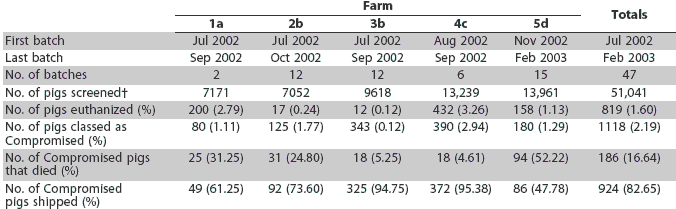
No ear-tagged pigs developed conditions requiring euthanasia after arrival. A summary of trial data is presented in Table 2.
Table 2: Summary information for a study* to determine whether compromised nursery pigs should be euthanized when identified at weaning or treated as required
* The study was conducted in five commercial nurseries (Herds 1 through 5) owned by four separate entities (a through d). Herds were part of three-site production systems. Pigs in each herd spent 6 weeks in the nursery and were housed and fed under similar conditions. Batches of pigs entering the nursery were assigned to one of three euthanasia protocols, conservative, medium, or aggressive, which triggered euthanasia by criteria described in Table 1. † Pigs were screened for compromising conditions upon entering the nursery and either euthanized or categorized as Compromised and tagged or penned normally, depending on individual conditions and the assigned treatment protocol. |
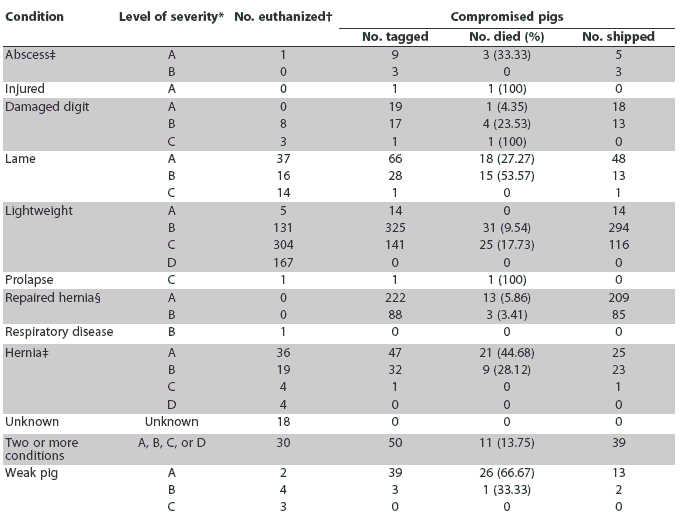
In seven Compromised categories (damaged digits, lame, lightweight, repaired hernia, hernia, weak, or two or more concurrent conditions), more than 10 pigs were classified as Compromised. In these categories, mortality ranged from 5.16% (repaired hernia) to 64.3% (weak). For welfare conditions associated with more than 10 pig deaths, the percentage of deaths increased as the level of severity increased. For example, there was a 27.27% death loss in lame pigs at welfare level A and a 53.57% death loss for lame pigs at welfare level B (Table 3). There was considerable variation in the number of pigs compromised for each condition, (eg, 1100 lightweight compared with 41 damaged digits) and the number of conditions reported (Herd 3b had 310 repaired hernias while other farms had none).
Table 3: Final disposition of nursery pigs in a study in five commercial nurseries to determine whether nursery pigs classified as Compromised should be euthanized when identified at weaning or treated as required (tagged)
* Level of severity as defined by an expert panel and detailed in Table 1. † Pigs euthanized at weaning according to the criteria in Table 1. ‡ One tagged pig was lost to follow-up. ¶ Scrotal or umbilical hernias repaired before the trial started. |
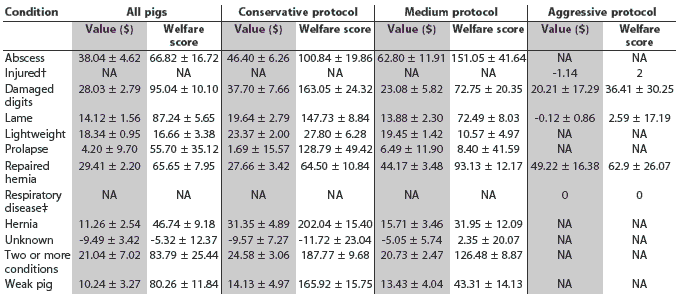
The mean value for Compromised pigs by farm under the conservative protocol ranged from $10.81 for Herd 5d to $48.99 for Herd 3b. For the aggressive protocol, mean value ranged from $0 (ie, all Compromised pigs were euthanized) to $46.66 (reflecting the survival and high value of the 310 pigs with repaired hernias on that farm) (Table 4). Least squares means analyses were not used because of the lack of variation in both the economic value and welfare cost under the aggressive protocol. Under the aggressive protocol, most Compromised pigs were euthanized, giving a zero value for both welfare and economic value. Under the conservative protocol, the mean welfare score for Compromised pigs by farm ranged from 73.51 for Herd 3b to 112.86 for Herd 1a. For the aggressive protocol, mean welfare score ranged from 0 (ie, all Compromised pigs were euthanized) to 59.68 (again reflecting the survival and daily accumulation of the welfare score of the 310 pigs with repaired hernias on that farm) (Table 4).The least squares means were calculated for all pigs and for pigs under the conservative and medium protocols (Table 5). Generally, the dollar value was numerically lower and the welfare score was numerically higher for pigs under the medium protocol than for those under the conservative protocol.
Table 4: Mean values* and welfare scores of pigs by farm and euthanasia protocol in a study in five commercial nurseries (described in Table 2) in which compromised pigs were identified at weaning, assigned welfare scores by a panel of experts, and either euthanized when identified or treated as required, according to the assigned euthanasia protocol
* The value of each compromised pig in each batch was established at shipping by partial budget [(additional income + reduced expenses) - (reduced income + additional expenses)]. Additional income was calculated as the product of weight at shipping and the standardized value of $1.78 per kg (all currency in $US). Additional expenses included the cost of treatment and, for pigs that died or were euthanized, the cost of feed consumed. † Scoring system described in Table 1. When more than one condition existed in an animal, scores were summed. Scores were applied daily and summed when the pig recovered, died, was euthanized, or moved to the finisher. ‡ Medium protocol not implemented. § All compromised pigs euthanized. NA = not applicable. |
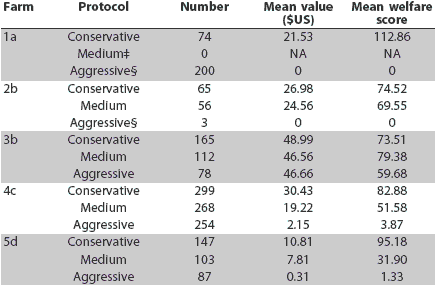
Table 5: Least squares means (+/- SE) of values ($US) and welfare scores of pigs in five commercial nurseries (described in Table 2) when three euthanasia protocols were used*
* Conservative, medium, and aggressive protocols as defined in Table 1. Means (not least squares means) were calculated for the aggressive protocol group because of the lack of variation in both the economic values and welfare scores. † Only one pig is represented, which was tagged and subsequently died. ‡ Only one pig is represented, which was euthanized upon entry into the nursery. NA = not applicable. |
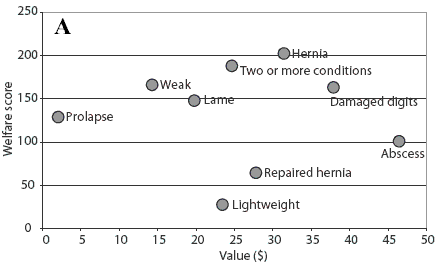
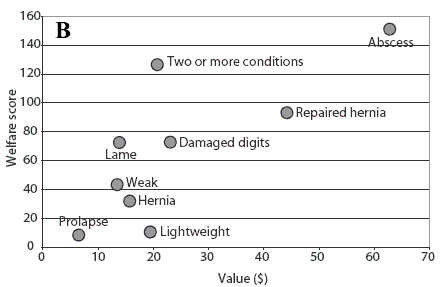
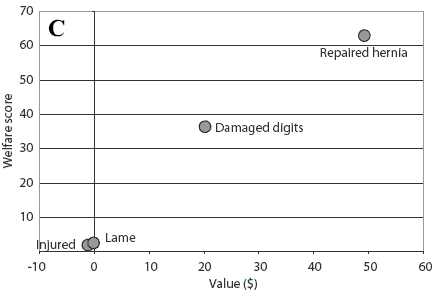
The comparisons of economic value and welfare scores by protocol and condition are illustrated in the scatterplots in Figure 1. For the conservative protocol, four conditions (prolapse, weak, lame, and the existence of two or more concurrent conditions) are in the top left quadrant, indicating a low value-high welfare score. For the medium protocol, only the existence of two or more concurrent conditions is associated with a low value-high welfare score, with a value of 126.
Figure 1: Scatterplots were constructed of the least squares means of the economic values and welfare scores for weaned pigs with conditions that were included as criteria for euthanasia in a study in five commercial nurseries comparing three euthanasia protocols (conservative, medium, and aggressive). The conditions that triggered euthanasia for each protocol are described in Table 1, and the participating farms and animals are described in Table 2. Conditions in the top left quadrant have low economic values combined with high welfare scores. In Figure 1A (conservative protocol), four conditions occupy this quadrant; in Figure 1B (medium protocol), only one condition, existence of two or more concurrent conditions, occupies this quadrant; and in Figure 1C (aggressive protocol), no conditions remain in this quadrant. Note the different scales of the axes in Figures 1A, 1B, and 1C.
|
Discussion
This study provides economic and welfare cost guidelines to help producers decide which nursery pigs to euthanize and when. Producers who adopt a policy of euthanizing more Compromised nursery pigs on arrival have the advantage of immediately improving the welfare status of the farm without incurring capital costs. High mortality was associated with level A weak pigs (66.67%), level B lame pigs (53.57%), and hernias of levels A and B combined (38%). This suggests that managers should examine the situation in their nurseries to determine if the opportunity exists to improve the welfare situation for these categories by immediately euthanizing more pigs affected by those conditions. The cost of the lost feed alone is a major expense when these pigs die, and welfare score improves when affected pigs are not on the farm, detracting from the overall welfare of the site. Current welfare concerns have focused primarily on issues such as gestation housing and processing (teeth and tail clipping and castration), but have largely ignored endemic health problems and management of those conditions by the animal caretakers.13 In our experience, veterinary or animal science students touring pig facilities are concerned about the welfare of individual animals visibly afflicted with conditions similar to the ones documented in this study. In addition to a visual assessment, a farm's records may indicate a welfare problem. Hurnik14 argues that longevity may be a good indicator of welfare, as it is logical to assume that premature death is preceded by a period of suffering. However, deciding to euthanize a Compromised pig immediately when it is detected results in foregoing the opportunity to return a profit from that pig.
Welfare and economics are necessarily linked in animal production, and increasingly, it is the consumer who defines welfare.11 Only time will tell if meeting welfare requirements will add to the cost of doing business, with the producer bearing all the cost, or if consumers will pay for the added cost and the assurance that welfare standards were adhered to.
The problems concerning accuracy of our welfare score is reflective of the problems with welfare indices generally, in which it is difficult to decide on the relative weightings. We used a simple descriptive scale (SDS) for our welfare index, with relative values assigned by consensus of a group of knowledgeable veterinarians. Pain scales adopted for use in animals include the SDS, the numerical rating scale (NRS),15 and the visual analog scale (VAS).16 Although the SDS is less sensitive than the NRS or the VAS, comparisons of inter-observer variability have shown reasonable agreement between observers using the SDS to assess postoperative pain in dogs.17 In contrast, there was considerable lack of agreement between observers using the VAS technique to score sheep lameness.18 With multiple observers and a desire to make the assessment system as practically applicable as possible, we therefore used an SDS, keeping the categories as unambiguous as possible. In many pain-scoring systems used in companion animals, no attempt is made to weight different behavioral signs in the scoring system, and such systems have been criticized on this basis.19 The issue of weighting specific conditions in assessment of animal welfare is far from resolved.20 However, we believe that for any assessment of welfare, or indeed pain, to be meaningful, it should incorporate some mechanism to allow for differences in the degree to which specific conditions compromise welfare. Our approach attempts to do this, and packages welfare assessment into a convenient and meaningful parcel that is focused and manageable in a farm setting where multiple observers are necessary.
The farm managers in this study seemed able to interpret our welfare guidelines. When presented with the "Pictorial welfare guidelines" produced for this study, managers seemed able to categorize welfare pigs, because few pigs subsequently died under the conservative protocol, fewer under the medium protocol, and fewer still under the aggressive protocol. However, herds vary in the prevalence of the conditions monitored, and farm managers need to focus on the conditions in their herds and adjust their protocols accordingly.
The scatterplots of welfare costs and economic values provide managers with concise visual representations of the options available to them as they try to optimize the welfare status of their herds while minimizing economic losses. For the conservative protocol, pigs with any of the four conditions in the top left quadrant have a comparatively low value and a high welfare score, and are therefore prime candidates for immediate euthanasia when managers want to improve herd welfare status. When the medium protocol is used, the only condition remaining in that quadrant is existence of two or more concurrent conditions, which can be removed by adopting the aggressive protocol (at least for that category).
The limitations of this study are that, although we screened 51,041 pigs and studied nearly 2000 pigs in five herds, the sample farms were convenience rather than random samples, and all pigs were in isolated nurseries in three-site production systems. Thus, care must be taken in extrapolating the results from this study to the US or global nursery-pig population. In addition, to enable us to compare results across the five study herds, we mathematically adjusted the ages and weights of pigs when they left the nursery to a standard 61 days. Consequently, this adjustment may not reflect the field situation where all pigs were not shipped to the finisher at exactly 61 days. In addition, we probably overestimated the weight of Compromised pigs that were not weighed at shipping but were assigned weights estimated from the average weight of their contemporaries. This would slightly overvalue those pigs and the values for their protocol.
This study provides economic and welfare information for nursery herd managers and their advisors, which they may use to begin to make a considered judgment on the impact of their decisions as to whether categories of Compromised nursery pigs should be immediately euthanized or kept and cared for until they are ready to move to the finisher.
Because of the high cost of compliance, many swine producers may find it difficult to access the emerging "welfare" markets.21 However, this report provides some of the data needed by producers to decide how they can improve the welfare status of pigs in their herds at a cost appropriate to their pork enterprise.
Implications
- By euthanizing more Compromised nursery pigs on arrival, managers can improve the welfare status of the herd.
- Under the conservative euthanasia protocol, pigs that are weak, lame, have prolapses, or have two or more concurrent conditions have a low value and high welfare score, and herd welfare cost can be decreased by immediately euthanizing most of these pigs.
- Herds vary in the prevalence of compromising conditions, and managers need to focus on the conditions in their herds and adjust their protocols accordingly.
Acknowledgements
The authors thank the National Pork Board for funding the project, Ms Stephanie Miller for her technical assistance, and all the farm managers for their generous cooperation.
References
1. Endenburg N, Vorstenbosch JM. Ethical issues in the ownership of companion animals: an empirical and normative analysis. Vet Q. 1992;14:129-136.
2. Cohen SP, Sawyer DC. Suffering and euthanasia. Probl Vet Med. 1991;3:101-109.
3. Hart LA, Hart BL, Mader B. Humane euthanasia and companion animal death: caring for the animal, the client, and the veterinarian. JAVMA. 1990;197:1292-1299.
*4. Arkow P. The humane society and the human-companion animal bond. Reflections on the broken bond. Vet Clin North Am Small Anim Pract. 1985;15:455-466.
5. Duncan JC. Careers in Veterinary Medicine. New York, New York: Rosen Publishing Group; 1988.
6. England DC. Husbandry components in prenatal and perinatal development in swine. J An Sci. 1974; 38:1045-1049.
*7. Hansen JA. Small pig technology: is it right for you? Carolina Swine Nutrition Conf. Research Triangle Park, North Carolina. 2003:1-6.
*8. On Farm Euthanasia of Swine - Options for the Producer. Booklet #04259-4/97. Des Moines, Iowa: American Association of Swine Veterinarians and the National Pork Board. 1997.
*9. On-Farm Euthanasia: Better Ways. Raleigh, North Carolina: Morrow WEM, Meyer RE, North Carolina State University College of Veterinary Medicine Biomedical Communications; 2001.
10. Brambell FWR. Report of technical committee to enquire into the welfare of animals kept under intensive husbandry systems. London, England: HM Stationery Office; 1965. Command 2836. Summary available at: http://www.fawc.org.uk/freedoms.htm. Accessed October 12, 2005.
11. Webster AJ. Farm animal welfare: the five freedoms and the free market. Vet J. 2001;161:229-237.
12. 2000 Report of the AVMA Panel on Euthanasia. J Am Vet Med Assoc. 2001;218:669-696.
13. Rushen J. Changing concepts of farm animal welfare: bridging the gap between applied and basic research. Appl Anim Behav Sci. 2003;81:199-214.
14. Hurnik JF. Welfare of farm animals. Appl Anim Behav Sci. 1988;20:105-117.
15. Lascelles BD, Butterworth SJ, Waterman AE. Postoperative analgesic and sedative effects of carprofen and pethidine in dogs. Vet Rec. 1994;134:187-191.
16. Lascelles BD, Cripps PJ, Jones A, Waterman AE. Post-operative central hypersensitivity and pain: the pre-emptive value of pethidine for ovariohysterectomy. Pain. 1997;733:461-471.
17. Holton LL, Scott EM, Nolan AM, Reid J, Welsh E, Flaherty D. Comparison of three methods used for assessment of pain in dogs. JAVMA. 1998;212:61-66.
18. Christley RM, Reid SWJ. No significant difference: use of statistical methods for testing equivalence in clinical veterinary literature. JAVMA. 2003;222:433-437.
19. Firth AM, Haldane SL. Development of a scale to evaluate postoperative pain in dogs. JAVMA. 1999;214:651-659.
20. Bracke MBM. Modeling in Animal Welfare [PhD thesis]. Wageningen, the Netherlands: Wageningen University; 2001.
21. Huirne R. Farm Animal Welfare in an Economic Context. 2000. Available at: http://agriculture.de/acms1/conf6/w5aeconom.htm . Accessed October 12, 2005.
* Non-refereed references.