
Original research |
Peer reviewed |
Effects of weaning age on postweaning belly-nosing behavior and umbilical lesions in a multi-site production system
Efectos de la edad al destete en la conducta post destete de trompeo del vientre y lesiones umbilicales en un sistema de producción de sitios múltiples
Les effets de l'âge de sevrage sur le comportement après le sevrage de flair de ventre et les lésions ombilicales dans un système de production des sites multiples
Rodger G. Main, DVM, PhD; Steve S. Dritz, DVM, PhD; Mike D. Tokach, PhD; Robert D. Goodband, PhD; Jim L. Nelssen, PhD; Thomas M. Loughin, PhD
RGM, SSD: Food Animal Health and Management Center and Department of Animal Sciences and Industry, Kansas State University, Manhattan, Kansas. MDT, RDG, JLN: Department of Animal Sciences and Industry, Kansas State University, Manhattan, Kansas. TML: Department of Statistics, Kansas State University, Manhattan, Kansas. Corresponding author: Dr Rodger G. Main, 301 Alexander Avenue Suite B, Ames, IA 50010; Tel: 515-663-9296; Fax: 515-663-9297; rodgermain@murphybrownllc.com. Contribution no. 04-044-J from the Kansas Agricultural Experimental Station, Manhattan, KS 66506.
Cite as: Main RG, Dritz SS, Tokach MD, et al. Effects of weaning age on postweaning belly-nosing behavior and umbilical lesions in a multi-site production system. J Swine Health Prod. 2005;13(5):259-264.
Also available as a PDF.
SummaryObjective: To determine the effects of weaning age on postweaning belly-nosing behavior and umbilical lesions in a commercial multi-site production system environment. Materials and methods: This study was conducted as a randomized complete block design. Treatments were weaning at 12, 15, 18, and 21 days of age (N = 2272 pigs). Each block was an off-site nursery, with four replicates (pens) of each treatment in each of four blocks. All pigs in a block were weaned from a 7300-head sow farm on the same day (Day 0). Each pen was observed for 15 minutes on Days 7, 14, and 21. Pigs demonstrating sustained belly-nosing behavior (>= 10 seconds) were recorded. After the observations on Day 21, the umbilical region of each pig was examined and scored for lesions associated with belly nosing. A repeated measures mixed model with linear and quadratic contrasts was used to test the effects of weaning age on belly-nosing prevalence, percentage of pigs classified as "nosers," umbilical lesion scores, and percentage of pigs with umbilical lesions at Day 21, with pen the experimental unit in all analyses. Results: Belly-nosing behavior and umbilical lesions were less frequent (quadratic, P < .05) as weaning age increased. Although the incidence of belly-nosing behavior gradually decreased as weaning age increased to 21 days, nosing activity and umbilical lesion scores nearly doubled as weaning age decreased from 15 to 12 days of age. Implications: Weaning pigs at less than 15 days of age significantly increases belly-nosing behavior and associated umbilical lesions. | ResumenObjetivo: Determinar los efectos de la edad al destete en la conducta post destete de trompeo del vientre y lesiones umbilicales en un sistema de producción de sitios múltiples, bajo un medio ambiente comercial. Materiales y Métodos: Este estudio se realizó como un diseño de bloques al azar. Los tratamientos fueron el destete a los 12, 15, 18 y 21 días de edad (N = 2272 cerdos). Cada bloque fue un destete externo, con cuatro réplicas (corrales) de cada tratamiento en cada uno de los cuatro bloques. Todos los cerdos en un bloque se destetaron de una granja de 7300 hembras en el mismo día (Día 0). Se observó cada corral durante 15 minutos los Días 7,14, y 21. Se registraron los cerdos que mostraron una conducta de trompeo continuo del vientre (>= 10 segundos). Después de las observaciones en el Día 21, se examinó la región umbilical de cada cerdo y se dieron puntajes por las lesiones asociadas con el trompeo del vientre. Se utilizó un modelo mixto de medidas repetidas con contrastes lineares y cuadráticos para probar los efectos de la edad al destete en la incidencia del trompeo del vientre, porcentaje de cerdos clasificados como "olfateadotes," puntaje de las lesiones umbilicales y porcentaje de cerdos con lesiones umbilicales en el Día 21, siendo el corral la unidad experimental en todos los análisis. Resultados: La conducta de trompeo del vientre y las lesiones umbilicales fueron menos frecuentes (P < .05 cuadrático) al aumentar la edad del destete. A pesar de que la incidencia de la conducta de trompeo del vientre disminuyó gradualmente al aumentar la edad del destete a 21 días, los puntajes de la actividad de trompeo y las lesiones umbilicales casi se duplicaron al disminuir la edad del destete de 15 a 12 días de edad. Implicaciones: Destetar a los cerdos antes de los 15 días de edad aumenta significativamente la conducta de trompeo del vientre y las lesiones umbilicales asociadas con él. | ResuméObjectif: Déterminer les effets de l'âge de sevrage sur le comportement après le sevrage de flair de ventre et les lésions ombilicales dans un système de production des sites multiples dans un environnement commercial. Matières et méthodes: Cette étude a été menée comme un dessin du bloc au hasard. Les traitements ont été le sevrage à 12, 15, 18, et 21 jours d'âge (N = 2272 cochons). Chaque bloc a été une pouponnière dehors, avec quatre réplications (parcs) de chaque traitement dans chacun de quatre blocs. Touts le cochons dans un bloc ont été sevrés d'une ferme de 7300 truies dans le même jour (Jour 0). Chaque parc a été observé pendant 15 minutes les Jours 7, 14, et 21. Les porcelets qui démontrent le comportement de flair de ventre soutenu (>= 10 secondes) ont été enregistrés. Après les observations du Jour 21, la région ombilicale de chaque porcelet a été examinée et marquée avec des points pour les lésions associées avec le flair de ventre. Un modèle de mesures répété mélangées avec les contrastes linéaire et quadratique a été utilisé pour tester les effets de l'âge de sevrage sur la survenance de flair de ventre, le pourcentage de porcelets classifiés comme flairons, les points marqués pour les lésions ombilicales, et le pourcentage de porcelets avec lésions ombilicales à Jour 21, le parc a été l'unité expérimentale dans toutes les analyses. Résultats: Le comportement de flair de ventre et les lésions ombilicales étaient moins fréquentes (P < .05 du second degré) à mesure que l'âge de sevrage a augmentée. Bien que la fréquence du comportement ait diminué progressivement à mesure que l'âge de sevrage augmenter à 21 jours, les points marqués pour le comportement et les lésions ombilicales presque ont doublé à mesure que l'âge de sevrage a diminuée de 15 à 12 jours d'âge. Implications: Sevrant les cochons à moins de 15 jours d'âge augmente considérablement le comportement de flair de ventre et les lésions ombilicales associés avec lui. |
Keywords: swine, weaning
age, belly
nosing, behavior, segregated early weaning, SEW
Search the AASV web site
for pages with similar keywords.
Received: October
4, 2004
Accepted: December
9, 2004
Belly nosing is a well described postweaning behavior in pigs.1,2 This behavior is characterized by repeated, rhythmic up-and-down massage movements with the snout directed towards another pig's umbilical or inguinal region. Nosing behavior begins approximately 4 days postweaning, peaking at 2 to 3 weeks postweaning,3,4 and may result in physical irritation and lesions in the umbilical region. Pigs that perpetrate this behavior have been reported to have inferior postweaning growth performance compared to "non-nosing" pen-mates of similar weaning weight.3 Gonyou et al (1998)4 found that pigs weaned at 12 days of age not only had more frequent nosing activity during the nursery phase of production, but also continued to nose and chew other pen-mates more during the finishing period, compared to pigs weaned at 21 days of age. Although the origins of this behavior have only been hypothesized, many theories suggest that belly-nosing behavior is an outward sign of postweaning stress. Some authors also have interpreted this outwardly expressed behavior as an indicator of a compromised state of animal welfare.5 Reducing weaning age increases the prevalence of belly-nosing.4-7 A recently reported multi-herd observational evaluation also found that nosing behavior was negatively correlated with weaning age.8 However, previously reported prospective studies have evaluated differences in belly-nosing behavior in pigs weaned at extreme differences in weaning age (ie, 12 or 21, 14 or 28, or 7, 14, or 28 days of age). Therefore, the objective of this study was to determine the effect that weaning age has on belly-nosing behavior and associated umbilical lesions over a range of weaning ages (12, 15, 18, and 21 days) commonly achieved in commercial multi-site pig production. Additionally, individual pig information was used to determine if either weaning weight or gender were within-pen (ie, age-group) risk factors associated with nosing behavior and umbilical lesions.
Materials and methods
Animals
This study was conducted on 2272 pigs (PIC 280 x C22) originating from a 7300-sow herd weaned into single-source, all in-all out nursery sites. Health of weaning groups from this sow farm was stable, ie, weaned pigs were free of significant clinical disease.
Housing, feeding, and management
Sows were housed in conventional indoor wire-floored farrowing stalls, each with a single rubber mat and a heat lamp serving as the piglet comfort area. Suckling pigs had continuous access to nipple waterers and were not fed creep-feed prior to weaning.
Pigs were weaned into single-room, all in-all out nursery sites, with a total of 64 nursery pens (2.44 m x 3.66 m) in four nursery sites (blocks) used in the study. Pens had wire flooring and two nipple waterers. Each pen contained a double-sided feeder with five feeding spaces on each side. All pigs were fed a common three-phase nursery feed budget.9 Pig environments and management practices were consistent with the standard nursery management practices implemented in this commercial pig production system.
Pigs were removed from test pens only in the case of acute death or if identified to be in a nonambulatory condition and not responding to medical treatment. Euthanasia was performed on nonambulatory pigs and they were recorded as mortality.
Animal welfare guidelines were in accordance with published guidelines.10
Experimental design
Treatments included weaning litters of pigs at 12, 15, 18, and 21 days of lactation. Three days prior to weaning, pigs were individually ear-tagged with a single uniquely numbered button-tag and were weighed. Weighing and tagging pigs prior to weaning was necessary due to labor availability.
The study was conducted in four randomized complete blocks, with all pigs within each block weaned on a single day (Day 0) into the same off-site, single-room nursery, and four replicate pens per weaning-age treatment per block. At weaning, pigs of each age group were allotted to treatments using individual pig-weight and gender information. Each pen contained an equal number of barrows and gilts, and represented the normal weight distribution of barrows and gilts weaned within the age group. Allotting pigs to treatment in this manner ensured that each pen served as a replicate of the population of pigs being weaned within weaning-age group and block. Pens contained 34 pigs in Block 1 and 36 pigs in Blocks 2, 3, and 4.
Pigs in each nursery pen were observed from the adjacent aisle for 15 minutes between 8:00 am and 10:00 am on Days 7, 14, and 21. Pigs demonstrating belly-nosing behavior (ie, sustained nosing activity >= 10 seconds) during the observation period were counted, and individual pig identification was recorded. Pigs identified as demonstrating belly-nosing behavior during at least one of the three observation periods were classified as "nosers".
Following the observation period on Day 21, the umbilical region of each pig was examined and subjectively classified as normal, moderate lesion, or severe lesion. The amount of inflammation, swelling, and physical deformity in the umbilical region were used to determine the classification by a single observer. All pens were weighed on Day 42, with individual pig weights recorded. Pen feed intake was recorded from Day 0 to 42. Additional information concerning the allotment of pigs to treatment and effects of weaning age on postweaning growth performance, postweaning mortality, and economic implications have been reported elsewhere.9,11
Calculations and statistical analysis
The effects of weaning age on belly-nosing prevalence (ie, percentage of pigs in a pen demonstrating belly-nosing behavior during an observation period) was evaluated using a repeated measures mixed model analysis in SAS version 8.1 (SAS Institute Inc, Cary, North Carolina). Pen was the experimental unit in all analyses. Best fitting covariance structure was chosen using the Akaike information criteria (AIC).12 Linear and quadratic contrasts were made, testing the effects of weaning age on postweaning belly-nosing prevalence. Similar contrasts were used to determine the effect of weaning age on the percentage of pigs classified as nosers, umbilical lesion scores, and the percentage of pigs with umbilical lesions at Day 21. Umbilical-region lesion-scoring classifications were assigned numeric values of normal = 0; moderate lesion = 5; severe lesion = 10. Standard errors (SED = standard error of difference) derived from statistical modeling described were included with results to illustrate the variability of the estimated differences between treatment means reported.
Additionally, a series of within-pen (or age-group) analyses were performed using individual pig information (ie, the individual pig was the observational unit in these analyses). Individual pig data was fit into a logistic regression model using the Genmod procedure in SAS version 8.1 (SAS Institute Inc, Cary, North Carolina). This model was used to determine if weaning weight or gender (within each pen or age group) affected the odds of being classified as a noser or having umbilical lesions at 21 days postweaning. Finally, individual pig data were fit into a mixed model (SAS Institute Inc) to determine if either being classified as a noser or having an umbilical lesion affected postweaning growth rate (Day -3 to Day 42).
Results
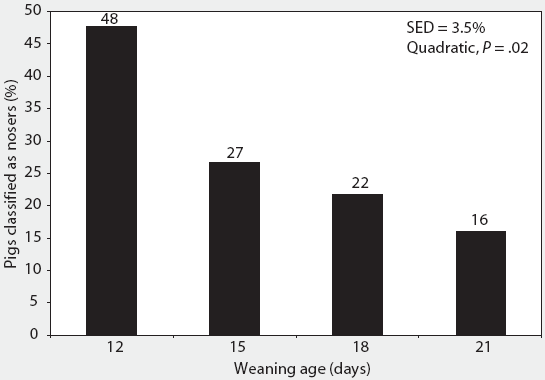
When the effects of weaning age on belly-nosing prevalence measured on Days 7, 14, and 21 were evaluated, there were no significant weaning-age-by-day-postweaning interactions (P > .05). Therefore, the fixed effects of weaning age and day postweaning are illustrated independently. The prevalence of belly nosing decreased (quadratic, P = .02) as weaning age increased, with the most profound difference in nosing prevalence occurring as weaning age increased from 12 to 15 days of age (Figure 1). Nosing behavior increased (quadratic, P < .001) in curvilinear fashion from 7 to 21 days postweaning, with peak activity observed during the Day 14 observation period (Figure 2). The percentage of pigs demonstrating belly-nosing behavior at least once during the three observation periods (ie, pigs classified as nosers) decreased (quadratic, P = .02) as weaning age increased, with the most substantial decrease in pigs classified as nosers occurring as weaning age increased from 12 to 15 days of age (Figure 3).
Figure 1: A total of 2272 pigs in 64 pens were used to determine the effects of weaning age (12, 15, 18, or 21 days) on postweaning belly-nosing behavior in the nursery of a commercial multi-site production system. The study was conducted in four randomized complete blocks, with all pigs within each block weaned on a single day into the same off-site nursery and four replicate pens per weaning-age treatment per block (34 pigs per pen in the first block and 36 pigs per pen in the other three). Prevalence was calculated as the mean percentage of the population in a pen observed demonstrating sustained belly-nosing activity for >= 10 seconds during a 15-minute observation period, as measured on days 7, 14, and 21 postweaning. A repeated measures mixed-model ANOVA was used to determine the effects of weaning age on belly nosing.
|
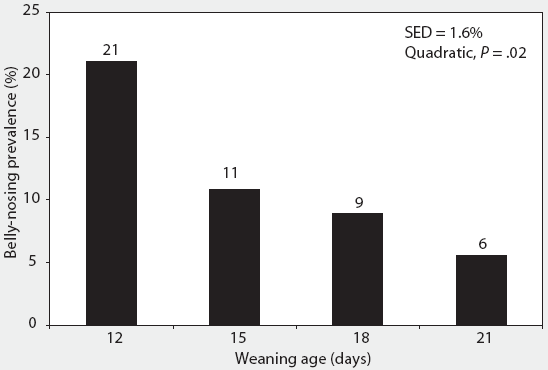
Figure 2: A total of 2272 commercial nursery pigs weaned at different ages were observed for 15 minutes on days 7, 14, and 21 postweaning in a commercial nursery environment. The study was conducted in four randomized complete blocks, with all pigs within each block weaned on a single day into the same off-site nursery, and four replicate pens per weaning-age treatment per block (34 pigs per pen in the first block and 36 pigs per pen in the other three). A repeated measures mixed model ANOVA was used to determine the effects of time postweaning on prevalence of belly-nosing behavior.
|
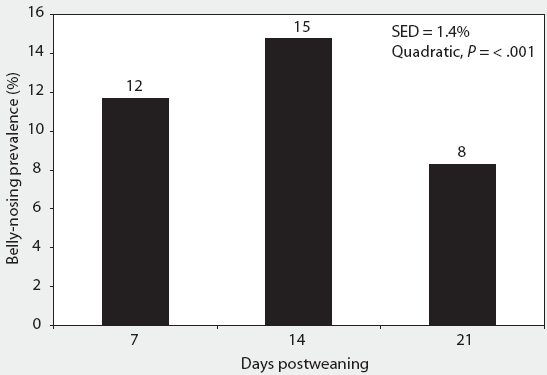
Figure 3: A total of 2272 commercial nursery pigs were observed on days 7, 14, and 21 postweaning. Individual pigs were classified as "nosers" if they were observed demonstrating belly-nosing behavior for >=10 seconds at least once during three 15-minute observation periods conducted on days 7, 14, and 21 postweaning. The study was conducted in four randomized complete blocks. All pigs within each block were weaned on a single day into the same off-site nursery, with four replicate pens per weaning-age treatment per block (34 pigs per pen in the first block and 36 pigs per pen in the other three blocks). A mixed model ANOVA was used to determine the effects of weaning age on proportion of pigs classified as nosers.
|
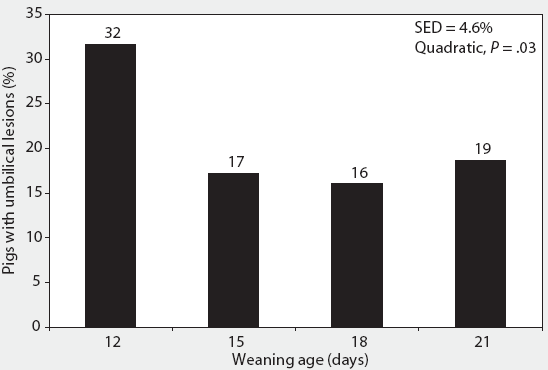
Both severity (Figure 4) and prevalence (Figure 5) of umbilical lesions decreased (quadratic, P < .05) as weaning age increased. Umbilical lesions were most severe and lesion prevalence was highest in pigs weaned at 12 days of age. Severity and prevalence of lesions were similar (P > .05) among the other three treatment groups.
Figure 4: A total of 2272 commercial nursery pigs were individually examined for umbilical lesions on day 21 postweaning in pigs weaned at 12, 15, 18, and 21 days of age. The study was conducted in four randomized complete blocks, with all pigs within each block weaned on a single day into the same off-site nursery, and four replicate pens per weaning-age treatment per block (34 pigs per pen in the first block and 36 pigs per pen in the other three blocks). Umbilical lesion scores were recorded by a single observer who subjectively evaluated the umbilical area of each pig and classified it as normal = 0, moderate lesion = 5, or severe lesion = 10, on the basis of the level of inflammation, swelling, or deformity present. A mixed model ANOVA was used to determine the effects of weaning age on umbilical lesion score.
|
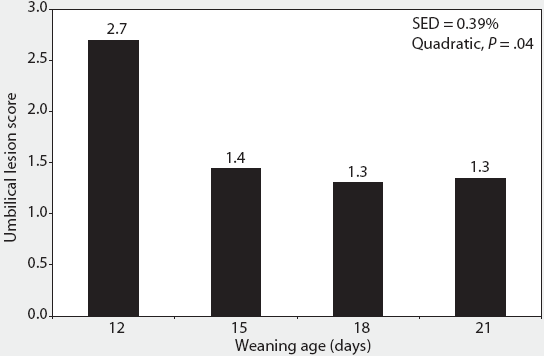
Figure 5: A total of 2272 commercial nursery pigs were individually examined for umbilical lesions on day 21 postweaning in pigs weaned at 12, 15, 18, and 21 days of age. The study was conducted in four randomized complete blocks, with all pigs within each block weaned on a single day into the same off-site nursery, and four replicate pens per weaning-age treatment per block (34 pigs per pen in the first block and 36 pigs per pen in the other three blocks). Umbilical lesion scores were recorded by a single observer who subjectively evaluated the umbilical area of each pig and classified it as normal = 0, moderate lesion = 5, or severe lesion = 10, on the basis of the level of inflammation, swelling, or deformity present. A mixed model ANOVA was used to determine the effects of weaning age on umbilical-lesion prevalence in pigs with umbilical lesions classified as either moderate or severe.
|
There was no association (P > .05) between gender and being classified as a noser for pigs of a common weaning age (ie, within a pen). However, nosing was associated with weaning weight (P = .02). The odds of being a noser decreased by 16% (95% CI; 4% to 27%) for each kg increase in weaning weight. Although statistically different (P = .02), average weaning weights for nosers (4.5 +/- 0.04 kg) and non-nosers (4.6 +/- 0.04 kg) were quantitatively similar. There was no association (P > .05) between weaning weight and having a lesion for pigs of a common weaning age (ie, within a pen). However, the odds of having an umbilical lesion were 2.31 times as high (P < .001) for barrows as gilts (95% CI; 1.82 to 2.93).
Postweaning growth rate (ADG) was lower (P < .001) for pigs classified as nosers (372 +/- 3 g per day) than for pigs classified as non-nosers (386 +/- 3 g per day). However, ADG (Day -3 to Day 42) for pigs with umbilical lesions (382 +/- 3 g per day) did not differ (P > .05) from that of pigs without umbilical lesions (377 +/- 3 g per day).
Discussion
The reduction in belly nosing associated with increasing weaning age observed in this study supports previous research indicating that pigs weaned at less than 3 to 4 weeks of age demonstrate more belly-nosing behavior.4-8 However, this study clarifies the shape of the relationship between weaning age and belly nosing in a commercial environment over a range of weaning ages commonly achieved in multi-site pig production. This study suggests that belly-nosing behavior increases gradually as weaning age is reduced from 21 to 15 days, and then increases dramatically as weaning age is reduced below 15 days of age. The peak in belly-nosing activity at 2 weeks postweaning was also consistent with previously published research.4 Umbilical lesion scores and prevalence resemble the shape of the belly-nosing-activity measurements, indicating that lesions associated with belly nosing increase as weaning age is reduced below 15 days of age.
It should be understood that the primary response criteria in this study (ie, belly-nosing behavior, umbilical lesion severity and prevalence) are somewhat subjective in nature, as they are based on visual observation. Although the observers were not aware of which weaning-age treatment was allocated to an individual pen, the effect of treatment on average body weight made it infeasible for observers to be totally unaware of which pens likely contained the younger, smaller pigs and which pens contained the larger, older pigs. However, a clear protocol was used, the observers were consistent throughout the study to minimize variation, and the observers had no reason to bias recorded observations.
Holhenshell et al (2000)13 did not observe differences in postweaning belly-nosing behavior in pigs weaned at 10 and 30 days of age. However, in that study, pen observations were made starting at 50 days of age (ie, 40 and 20 days postweaning for pigs weaned at 10 and 30 days, respectively). Because these direct behavioral observations were made at designated days of age, it is possible that the effects of time post-weaning masked weaning-age-related effects. Additionally, pigs in the Holhenshell et al13 study were housed at a density of four pigs per pen. Therefore, group size is another potentially confounding difference between the Hohenshell et al research and this study.
Within a common weaning-age group, a pig that was lighter at weaning had marginally higher odds of being classified as a belly noser. The significance of weaning weight is not consistent with research reported by Straw and Bartlett (2001),3 who found that weaning weight did not alter the odds of pigs demonstrating belly-nosing behavior. However, the statistical association between weaning weight and belly-nosing behavior does not appear to be of great quantitative importance in the current study. The number of pigs in this study enables the analysis to detect associations that may be statistically significant, but not necessarily quantitatively important. Individual pig data analyses suggest nosing behavior is independent of gender, and that weaning weight has only marginal effects on nosing behavior. The lack of a gender effect on nosing, the negative effect of nosing on growth performance, the higher incidence of umbilical lesions in barrows than in gilts, and the lack of effect of umbilical lesions on growth performance in this study are all consistent with the results reported by Straw and Bartlett.3 Although gender had no effect on the odds of a pig demonstrating belly-nosing behavior, the location of the prepuce near the umbilicus seems to make barrows more vulnerable than gilts to significant tissue damage and inflammation associated with being nosed.
Gardner et al (2001)14 determined that altering diet quality and the inclusion of milk in the diet had no effect on belly-nosing behavior in pigs weaned at 14 to 18 days of age. Similarly, Weary et al (1999)7 found no effect of diet quality on nosing behavior in pigs weaned at 28 days of age. Dybkjaer (1992)2 demonstrated that the combination of increasing floor space and providing straw each day reduced belly nosing in 4-week-old weaned pigs. However, increasing floor space and adding straw were not evaluated independently. Torrey and Widowski (2004)15 found that 15-day-old weaned pigs using bowl waterers spent less time belly-nosing than did pigs using nipple waterers, and that simulated sounds of sow vocalization had no effect on postweaning belly-nosing behavior. Widowski et al (2003),8 in an 11-herd observational study, observed a substantial level of belly-nosing activity in one herd in which pigs were weaned at 26 days of age, suggesting that factors other than weaning age influence belly-nosing behavior. Additionally, these authors observed a higher level of overall activity in this herd, and the affected farm received the lowest biosecurity score of all farms surveyed, suggesting a lower level of management intensity.
Weaning age, weaning weight, gender, type of waterer, diet quality, and sounds of sow vocalization have been factors prospectively evaluated to determine their influence on postweaning belly-nosing behavior. Of these, increasing weaning age and using bowl waters (ie, not traditional nipple waterers) appear to be management inputs that reduce belly nosing. This study suggests that weaning pigs at less than 15 days of age dramatically increases nosing behavior and associated lesions. However, within a common weaning age, increasing weaning weight appears to have only a marginal sparing effect on nosing behavior. Under the conditions of this study, weaning pigs at less than 15 days of age, irrespective of weaning weight, significantly increases postweaning nosing behavior. In production operations experiencing postweaning belly-nosing behavioral problems, age at weaning should be considered a primary predisposing factor.
Implications
- Under the conditions of this study, prevalence of postweaning belly nosing and severity of associated umbilical lesions increase dramatically as weaning age is reduced below 15 days of age.
- Under the conditions of this study, weaning age has a greater influence on belly nosing than weaning weight.
- Under the conditions of this study, nosing behavior is strongly associated with lower ADG in the initial 42 days postweaning.
- Weaning age is a primary factor to be evaluated when a high prevalence of postweaning belly-nosing activity and associated lesions are observed.
References
1. Blackshaw JK. Some behavioral deviations in weaned domestic pigs: persistent inguinal nose thrusting, and tail and ear biting. Anim Prod. 1981;33:325-332.
2. Dybkjaer L. The identification of behavioral indicators of stress in early weaned piglets. Appl Anim Behav Sci. 1992;35:135-147.
3. Straw BE, Bartlett P. Flank or belly nosing in weaned pigs. Swine Health Prod. 2001;9:19-23.
4. Gonyou HW, Beltranena E, Whittington DL, Patience JF. The behaviour of pigs weaned at 12 and 21 days of age from weaning to market. Can J Anim Sci. 1998;78:517-523.
5. Worbec EK, Duncan IJH, Widowski TM. The effects of weaning at 7, 14, and 28 days on piglet behavior. Appl Anim Behav Sci. 1999;62:173-182.
6. Metz JHM, Gonyou HW. Effect of age and housing conditions on the behavioral and hemolytic reaction of piglets to weaning. Appl Anim Behav Sci. 1990;27:299-309.
7. Weary DM, Appleby MC, Fraser D. Responses of piglets to early separation from the sow. Appl Anim Behav Sci. 1999;63:289-300.
8. Widowski TM, Cottrel T, Dewey CE, Friendship RM. Observations of piglet-directed behavior patterns and skin lesions in eleven commercial swine herds. Swine Health Prod. 2003;11:181-185.
9. Main RG, Dritz SS, Tokach MD, Goodband RD, Nelssen JL. Increasing weaning age improves pig performance in a multisite production system. J Anim Sci. 2004;82:1499-1507.
10. Federation of Animal Science Societies. Guide for the Care and Use of Agricultural Animals in Agricultural Research and Teaching. 1st rev ed. Savoy, Illinois: Federation of Animal Science Societies; 1999.
11. Main RG, Dritz SS, Tokach MD, Goodband RD, Nelssen JL. Increasing weaning age improves pig performance in a multisite production system. Swine Health Prod. 2005;13:189-197.
*12. Littell RC, Ramon C, Stroup WW, Freund RJ. SAS" System for Mixed Models. Cary, North Carolina: SAS Institute Inc; 2002.
13. Hohenshell LM, Cunnick JE, Ford SP, Kattesh HG, Zimmerman DR, Wilson ME, Matteri RL, Carroll JA, Lay DC Jr. Few differences found between early- and late-weaned pigs raised in the same environment. J Anim Sci. 2000;78:38-49.
14. Gardner JM, de Lange CFM, Widowski TM. Belly-nosing in early-weaned pigs is not influenced by diet quality or the presence of milk in the diet. J Anim Sci. 2001;79:73-80.
15. Torrey S, Widowski TM. Effect of drinker type and sound stimuli on early-weaned pig performance and behavior. J Anim Sci. 2004;82:2105-2114.
* Non-refereed reference.