
What's your interpretation? |
Non refereed |
Use of statistical process control in finishing records
Chris Rademacher, DVM
New Fashion Pork, 164 Industrial Parkway, Jackson, MN 56143; Tel: 507-847-4610; Fax: 507-847-4125; E-mail: cjrademacher@nfpinc.com
Cite as: Rademacher C. Use of statistical process control in finishing records. J Swine Health Prod. 2004;12(3):158-159.
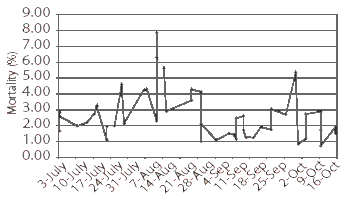
This chart shows the percent mortality during the first 7 weeks on feed for finishing groups within the same system over a period of approximately 4 months. Groups are plotted consecutively by group-end date. An intervention had been applied to improve the quality of pigs placed in the finishers, starting with group-end date August 29, 2003. Did this intervention reduce finishing mortality? What other analysis would you perform on the data to improve your certainty that the intervention was or was not effective?
Statistical process control (SPC) was devised to track a system's perfor- mance, in order to determine whether changes made to the processes result in real changes in the outcome.1 One tool used in SPC is the control chart, which is created by plotting individual measurements consecutively over time and calculating the overall average and the upper and lower control limits, which provide a visual means for understanding the amount of variation or "noise" inherent to the system. Using a set of rules derived from statistics, one can rapidly determine whether a change to the system has resulted in a statistically significant change in the measured outcome.
Finishing mortality data may be collected easily by farm staff with a high degree of confidence. Since specific diseases and syndromes affect finishing pigs at different ages, an overall mortality figure may cloud understanding of mortality occurring at different stages. In this example, it was decided to target mortality during the first 7 weeks in the finisher, which is usually affected by the quality of pigs arriving from the nursery and the occurrence of diseases that affect pigs early in the finishing period.
Percent finishing mortality that occurred during the first 7 weeks on feed was calculated from consecutive close-outs for group-end dates January 1, 2003, to December 20, 2003 (ie, the total number of pigs lost during their first 7 weeks in the finisher was divided by the beginning inventory). In this production system, three 1000-head finishing barns are filled weekly, and a finishing group is equivalent to a barn of pigs. Control charts for barn mortality values (X-charts) were constructed by plotting the individual barn data consecutively. The individual mortality values were then averaged to create the central line for the X-chart (average of X). The range of individual values was obtained by calculating the differences between successive pairs of values. The upper and lower control limits were calculated as follows:
- X-chart upper natural process limit = average of X + (2.66 x average of the ranges);
- X-chart lower natural process limit = average of X - (2.66 x average of the ranges).
The process is determined to be out of control (ie, there is a signal) if any of the following three criteria are true:
- Rule #1: A single value is beyond the limits of the control chart.
- Rule #2: Three of four values are closer to one of the limits than to the central line.
- Rule #3: Eight or more successive points fall on one side of the central line.
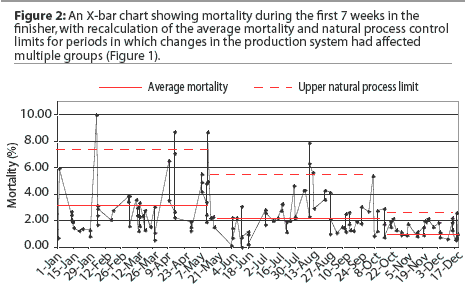
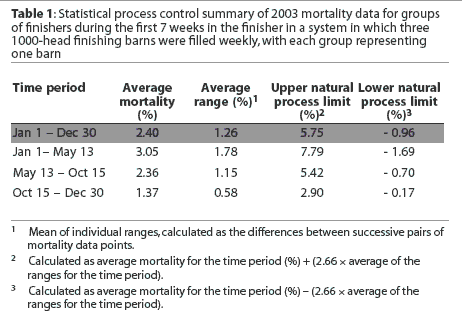
For the year 2003, a few individual groups in the overall early finishing mortality for this system were "out of control," according to Rule #1 (Figure 1). In these cases, unusual circumstances existed, such as a TGE outbreak, extreme weather conditions, and a facility or labor problem. For the groups closing out in mid-May and June, an improvement in mortality for weeks 1 to 7 was seen according to Rules #2 and #3 (Figure 1). This indicated that a change in the system had affected more than one group. It turned out that, during this time, a number of nursery depopulation-repopulations had occurred. The average and control limits were reset (Figure 2), and it was found that average mortality had decreased from 3.05% to 2.36% (Table 1).
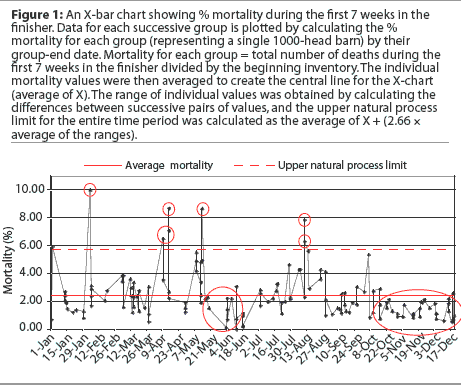
It is generally accepted that depopulation-repopulation results in a temporary improvement in performance. This was observed before mortality began to increase in the June groups (Figure 1).
The system's management team decided to test another intervention, starting with the group-end date August 29, 2003. Sows were vaccinated with a bivalent influenza vaccine twice prefarrowing, instead of only once. The pigs began to appear healthier in the early finishing phase, and mortality declined for the first six groups ending in September. However, a signal was not observed due to high mortality in two finishing groups in mid-September. Subsequently, a Rule #3 signal was observed for group-end dates starting on October 15, 2003 and continuing through to December. The midline was recalculated for the time period after the signal, and it was found that mortality for the first 7 weeks in the finisher had decreased from 2.36 % to 1.37% (Figure 2).
It is quite possible that the change in vaccination schedule did improve early finishing performance during the early fall, when early respiratory disease pressure is more prevalent. However, since the controls were groups in the "before" time frame and the treatments were in the "after" time frame, a cause-and-effect relationship cannot be guaranteed. For instance, the improvement in mortality for weeks 1 to 7 in this case was temporally associated with the intervention; however, another unrecognized factor might also be at work, such as variation in the quality of facilities. From this point of view, SPC might be misleading. Nevertheless, in a production situation, "before-and-after" measurements are often the only data available, and providing that those interpreting the data have a good knowledge of the multitude of inputs on the system and how they interact, SPC may be a useful analytical tool.2
References
1. Wheeler D. Understanding Variation: The Key to Managing Chaos. Knoxville, Tennessee: SPC Press; 1993:135.
2. Radostits OM. Herd Health: Food Animal Production Medicine. 3rd ed. Philadelphia, Pennsylvania: WB Saunders Company; 2001:107-141.