
Practice tip |
Non refereed |
Effective environmental temperature
John E. Baker, DVM
Warrick Veterinary Clinic, 8866 Telephone Road, Chandler, IN 47610; Tel: 812-897-4855; E-mail: wvcjeb21256@aol.com
Cite as: Baker JE. Effective environmental temperature. J Swine Health Prod. 2004;12(3):140-143.
In practice, you may be introduced to concepts or principles that allow you to understand what you have observed but were unable to explain. For me, such moments are exciting and satisfying. One such concept has proven invaluable in explaining why pigs respond to their thermal environments in ways that result in suboptimal performance or disease outbreaks. This is the concept of "effective environmental temperature," which explains why air temperature is only one factor in determining what the animal senses as comfortable. It also explains why animals seem to be chilled even though the temperature on the thermostatic controller is set in the animals' comfort zone.
Animals experience optimal performance and health in their thermoneutral or comfort zone. If the temperature is above or below this range, the animal experiences heat or cold stress, respectively. The temperature the animal experiences (ie, the effective environmental temperature) is the temperature measured by a thermometer increased or decreased by other factors in the environment. These factors include heat loss by convection, conduction, and radiation. When the effective temperature falls below the animal's lower critical temperature (LCT), the animal's performance or health is sacrificed. The pig's LCT is based on its body weight and age, as shown in Table 1.
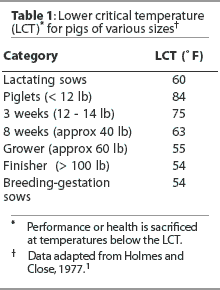
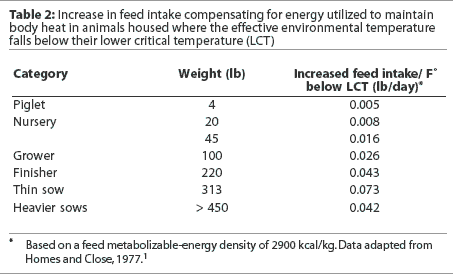
These temperatures seem much lower than the thermostat settings commonly used for environmental controllers in swine barns, but remember, these are the effective environmental temperatures, not the temperature of mercury in a vacuum. Animals housed where the effective environmental temperature falls below their LCT increase their feed intake to compensate for energy utilized to maintain body heat, as shown in Table 2. This feed intake is for heat production only and does not result in increased body weight, thereby reducing feed efficiency.
Convection heat loss
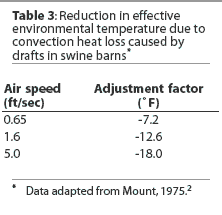
Convection heat loss is caused by air movement over an object. This occurs in swine barns due to drafts caused by air movements from air inlets to exhaust fans in mechanically ventilated buildings, or by breezes or wind in naturally ventilated buildings. The rule of thumb for the minimum threshold of draft stress is 0.5 feet per second (30 feet per minute) for pigs weighing less than 40 pounds, and 40 to 50 feet per second for grower and finishing hogs (J. M. McFarlane, written communication, 1990). If air speed is greater than this, effective environmental temperature is reduced, as shown in Table 3.
Conduction heat loss
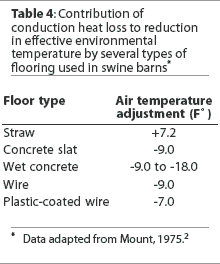
Conduction heat loss is heat transferred to a solid object in contact with the animal, primarily flooring. Whether or not floors are wet plays a significant role in conduction heat loss. The contributions of several floor types to reduction in effective environmental temperature are listed in Table 4.
Radiation heat loss
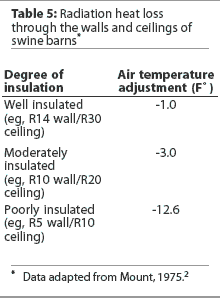
The loss of heat through the air between areas of different temperatures is called radiation heat loss. This type of heat loss is associated with the insulation value in the ceiling and walls of buildings (Table 5).
Other factors influencing effective environmental temperature in swine
Evaporative coolers reduce the effective environmental temperature by approximately 6 to 8 F degrees under typical Midwest summer weather conditions.3 By huddling, pigs can reduce environmental thermal demand and heat loss by up to 40%. Grow-finish pigs reduce daily intake of a typical corn-soy ration by approximately 0.92% for every F degree rise in effective environmental temperature above 70°F.4 This does not reduce feed efficiency until the temperature exceeds 90°F. Therefore, the cost factors related to reduced feed intake between 70 and 90°F are those that slow growth rate and increase days to market.
Assessing pigs' thermal comfort
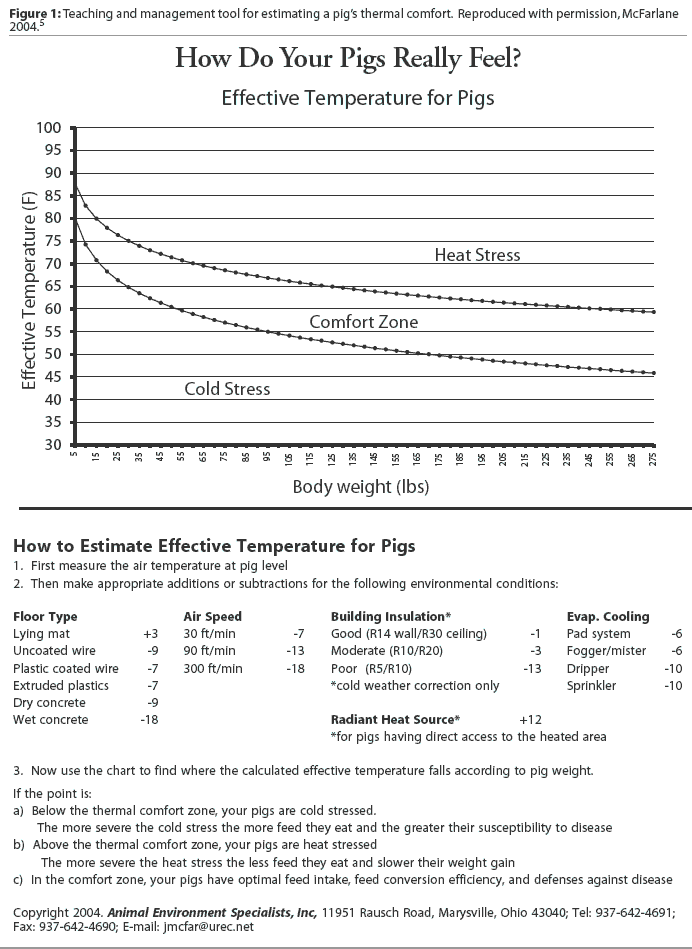
A pig's thermal comfort can be roughly estimated by adding or subtracting from the air temperature other known environmental influences, including air velocity, floor type and condition, building insulation level, and evaporative cooling. This approach, first suggested by Mount (1975)2 and applied practically to swine production environments by Curtis (1983),4 has been further adapted for ease of use by veterinary practitioners and pork producers in a one-page teaching and management tool (Figure 1, reprinted with permission from Dr J. M. McFarlane).5
Practical applications of the concept of effective environmental temperature
In the last few months, I have used the concept of effective environmental temperature to prevent or reduce the severity of several health problems in swine units I serve. A couple of those examples are listed below.
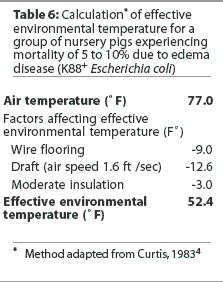
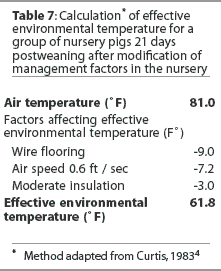
Example 1. Two units were experiencing nursery mortalities of 5 to 10% due to K88+ Escherichia coli edema disease occurring at 21 to 28 days of age. Both units weaned pigs into rooms at temperatures of 85 to 86°F, and dropped the temperatures in the nursery rooms very rapidly, about 1 F degree every other day, starting 4 days after weaning. This meant that by day 21 postweaning, the room temperature was 76 to 77°F. Using the described adjustment factors, the effective environmental temperature for these 6- to 7-week-old pigs was calculated at 52.4°F (Table 6), well below the LCT of 63°F for 8-week-old pigs. Chilling slows gut motility, resulting in increased absorption of toxins and increased severity of clinical signs. I recommended reducing the nursery room set point temperature by 1 degree every Monday and Thursday. This resulted in a room temperature of 81°F at 21 days postweaning. To reduce drafts in the room, the room controllers were set to widen the differential settings so that the minimum speed of the fans at each stage was reduced. The effective environmental temperature increased to 61.8°F (Table 7). Although this is still a little below the pigs' LCT, death loss was reduced in both herds to 2 to 3%. The problem has not yet been totally eliminated; however, we have dramatically reduced the severity by reducing stress on the pigs.
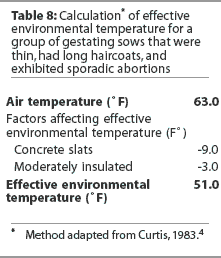
Example 2. One of my clients went through a herd depopulation and repopulation. The new animals were much leaner than his previous genetics. When winter arrived, the sows became thin and developed long hair coats. Sporadic abortions occurred throughout the gestation barn. The gestation room temperature was set at 63°F, well above the LCT for sows, which is 54°F. However, factors that affect the animal's perception of temperature were used to calculate the effective environmental temperature, which was 51°F (Table 8). We increased the room temperature to 71°F, resulting in an effective environmental temperature of 59°F. Daily feed intake dropped from 8 pounds per day to 4.5 pounds per day, and sows quickly returned to condition.
I have found the concept of effective environmental temperature invaluable in educating my clients and myself as to why the pigs' response to an environment is not always what is expected by looking at the thermometer.
I would like to thank Dr Jim McFarlane for enlightening me with this concept a number of years ago and improving my ability to assist my clients. I further appreciate Dr McFarlane's reviewing this article and contributing the teaching and management tool, "What do your pigs really feel?" illustrated in Figure 1. I hope some of you will read this Practice tip and become excited and satisfied that what you have observed can be explained.
References
1. Holmes CW, Close WH. In: Haresign W, Swan H, Lewis D, eds. Nutrition and the Climatic Environment. London: Butterworths; 1977.
2. Mount LE. The assessment of thermal environment in relation to pig production. Livest Prod Sci. 1975; 2:381.
3. VanFossen L, Meyer VM. Evaporative cooling for swine. Iowa Cooperative Extension Services Publication. 1971. Pm-503.
4. Curtis, SE. Thermal-environmental requirements. In: Environmental Management in Animal Agriculture. Ames, Iowa: Iowa State University Press; 1983:77.
*5. McFarlane JM. How do your pigs really feel? Marysville, Ohio: Animal Environment Specialists; 2004.
* Non-refereed reference.