
Original research |
Peer reviewed |
Effects of weaning age on growing-pig costs and revenue in a multi-site production system
Efecto de la edad de destete en los costos y rentabilidad de los cerdos en crecimiento en un sistema de producción de sitios múltiples
Les effets de l'âge de sevrage sur les coûts et les revenus des porcs dans la croissance dans un système de production de sites multiples
Rodger G. Main, DVM, PhD; Steve S. Dritz, DVM, PhD; Mike D. Tokach, PhD; R.D. Goodband, PhD; Jim L. Nelssen, PhD
RGM, SSD: Food Animal Health and Management Center and Department of Animal Sciences and Industry, Kansas State University, Manhattan, Kansas. MDT, RDG, JLN: Department of Animal Sciences and Industry, Kansas State University, Manhattan, Kansas. Corresponding author: Dr Rodger G. Main, 301 Alexander Avenue Suite B, Ames, IA 50010; Tel: 515-663-9296; Fax: 515-663-9297; E-mail: rodgermain@murphybrownllc.com
Cite as: Main RG, Dritz SS, Tokach MD, et al. Effects of weaning age on growing-pig costs and revenue in a multi-site production system. J Swine Health Prod. 2005;13(4):189-197.
Also available as a PDF.
SummaryObjective: Two trials were conducted to determine the effects of weaning age on growing-pig costs and revenue in a multi-site production system. Materials and methods: In Trial One (2272 pigs), litters were weaned at 12, 15, 18, and 21 days of age. In Trial Two (3456 pigs), litters were weaned at 15, 16, 18, 19, 21, and 22 days of age and categorized into three treatments (15.5, 18.5, and 21.5 days of age). In Trial Two, pigs in each age group were fed one of two nursery feeding programs. Each trial was conducted as a randomized complete block design with four blocks of nursery and finishing sites. All pigs within each block were weaned from a 7300-head sow farm on the same day into the same nursery, with each block remaining intact through finishing. Costs and revenue were calculated for each pen and modeled to simulate situations of either limited or nonlimited finishing space. Results: In both trials and both finishing capacity scenarios (limited or nonlimited), weight sold per pig weaned, wean-to-finish cost per 100 kg sold, and income over costs improved (linear, P < .05) as weaning age increased. Altering the nursery feeding program did not affect pig performance in Trial Two (P > .05). Implications: Under the conditions of these trials, the value of weaned pigs increases with weaning age whether finishing space is limited or nonlimited. Linear increases (P < .05) in growth rate and livability were the drivers of the economic advantages of increasing weaning age. | ResumenObjetivos: Se realizaron dos pruebas para determinar el efecto de la edad de destete en los costos y la rentabilidad de los cerdos en crecimiento en un sistema de producción de sitios múltiples. Materiales y Métodos: En la Prueba Uno (2272 cerdos), las camadas se destetaron a los 12, 15, 18 y 21 días de edad. En la Prueba Dos, (3456 cerdos), las camadas se destetaron a los 15, 16, 18, 19, 21 y 22 días de edad y se categorizaron en tres tratamientos (15.5, 18.5 y 21.5 días de edad). En la Prueba Dos, los cerdos fueron alimentados con uno de dos programas de alimentación de destete. Cada prueba se realizó con un diseño de bloque completo al azar con cuatro bloques en los sitios de destete y de finalización. Todos los cerdos en cada uno de los bloques se destetaron de una granja de 7300 hembras, el mismo día, al mismo destete y cada bloque permaneció intacto hasta la finalización. Se calcularon los costos e ingresos para cada corral y se modelaron para simular situaciones de espacio de finalización limitado o no limitado. Resultados: En ambas pruebas y en ambos escenarios de capacidad de finalización (limitada o no limitada), el peso vendido por cerdo destetado, costo de destete a finalización por 100 kg vendidos, y los ingresos sobre los costos mejoraron (P < .05 linear) al incrementar la edad de destete. El cambio en el programa de alimentación del destete no afectó (P > .05) el desempeño de los cerdos en la Prueba Dos. Implicaciones: Bajo las condiciones de estas pruebas, el valor de los cerdos destetados aumenta con la edad del destete ya sea que el espacio de la finalización sea limitado o no limitado. El aumento lineal (P < .05) en el crecimiento y la probabilidad de supervivencia fueron los motivadores de las ventajas económicas del aumento en la edad del destete. | ResuméObjectifs: Deux épreuves ont été faites pour déterminer les effets de l'âge de sevrage sur les coûts et les revenus des porcs dans la croissance dans un système de production de sites multiples. Matières et méthodes: Dans l'Épreuve Un (2272 porcs), les portées ont été sevrées à 12, 15, 18, et 21 jours d'âge. Dans l'Épreuve Deux (3456 porcs), les portées ont été sevrées à 15, 16, 18, 19, 21, et 22 jours d'âge et ont été catégorisé dans trois traitements (15.5, 18.5, et 21.5 jours d'âge). Dans l'Épreuve Deux, les porcs dans chaque groupe d'âge ont été nourris une de deux programmes de alimentation dans la pouponnière. Chaque épreuve a été fait comme un dessin du bloc complet au hasard avec quatre blocs de pouponnière et finition. Tout les porcs dans chaque bloc ont étés sevrés d'une ferme de 7300 truies le même jour, a la même pouponnière, et chaque bloc a resté intact jusqu'au finition. Les coûts et les revenus ont été calculés pour chaque parc et ont été modelé pour simuler des situations d'espace de finition soit limité et soit sans limite. Résultats: Dans les deux épreuves et les deux scénarios de capacité de finition (limité ou sans limite), le poids vendu par porc sevré, le coût de sevrage- à-finition par 100 kg vendu, et les revenus sur les coûts ont améliorés (P < .05 linéaire) comme l' âge de sevrage augmentait. Le changement du programme d'alimentation a la pouponnière n'a pas affecté (P > .05) la performance des porcs dans l'Épreuve Deux. Implications: Sous les conditions de ces épreuves, la valeur des porcs sevrées augmente avec l'âge de sevrage si l'espace de finition est limité ou sans limite. Las augmentations linéaires (P < .05) dans la croissance et la probabilité de survivance ont été les conducteurs des avantages économiques de l'augmentation de l'âge de sevrage. |
Keywords: swine, weaning
age, economics, segregated early weaning, multi-site
production
Search the AASV web site
for pages with similar keywords.
Received: March
5, 2004
Accepted: June
22, 2004
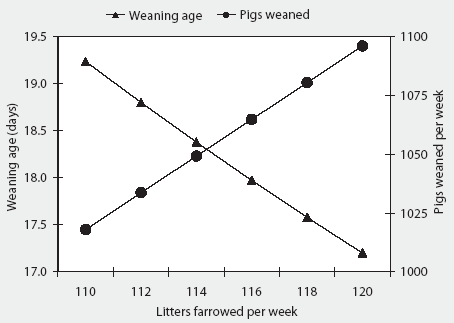
Numerous methods have been described for estimating the value of weaned pigs in multi-site production.1-4 Although most producers have individual weaned-pig quality criterion or discount programs, pigs meeting the minimum standards are commonly valued equally. Additionally, the development of multi-site production systems has encouraged the financial performance for each phase of production (sow, nursery, finishing, or wean-to-finish) to be independently evaluated. The sow herd is either a cost or a profit center depending on whether ownership of the weaned pig is transferred at weaning. Regardless of whether the sow herd is a cost or profit center, sow herd revenue and production costs are commonly calculated on a per-weaned-pig basis. In contrast, other phases of production use weight to derive cost and revenue. Thus, the accepted standard for measuring cost and revenue assumes that all weaned pigs meeting minimum standards have equal value. These accepted accounting practices may encourage a reduction in weaning age. Increasing the number of sows farrowing per week commonly increases pigs weaned per week, but also requires weaning age to be reduced when there is a fixed amount of lactation space available. The modeled effects of increasing litters weaned per week in a 2600-head sow unit with 384 lactation crates is shown, to illustrate the competing interests of weaning age and number of pigs weaned in a sow farm constrained by its lactation space (Figure 1). In this example, increasing weekly farrowings from 110 to 120 sows per week increases pigs weaned by 78 per week and requires weaning age to be reduced by approximately 2 days.
Figure 1: The effects of increasing litters farrowed per week on weaning age and pigs weaned in a 2600-head sow herd with 384 lactation crates was modelled to illustrate the competing interests of pig weaned and weaning age in a sow farm constrained by its lactation space. In this modeled example, a 0.10-pig increase in total born on sow litters and a 0.05% increase in preweaning mortality are recognized for each 1-day decrease in lactation length.5
|
Weaning at a younger age and segregated production have proven to be effective strategies to produce pigs free of specific pathogens endemic in the source herd.6-8 However, targeted pathogen elimination is commonly not the driver of weaning age in commercial pig production. Weaning age is more commonly an outcome determined by the number of sows farrowed each week, lactation space capacity, and the efficiency with which the lactation spaces available are being used. The performance improvements associated with segregated early weaning may be evident when pigs are weaned at 5 to 28 days of age.8 However, little research has evaluated the economic differences that result from altering weaning age within this range. Therefore, our objective was to evaluate the effects of weaning age on wean-to-finish costs and revenue in a multi-site production system. The intent was to bring any differences observed in wean-to-finish costs or revenue back to a per-pig-weaned basis, thus enabling a clear determination of how weaning age affects weaned-pig value within a multi-site production system.
Materials and methods
Animals and procedures
A detailed account of the methods used to evaluate the biological responses in these two studies has been previously described.9 Therefore, only an abbreviated overview is described. Two trials were conducted to determine the effects of weaning age on growing-pig biologic and economic performance in a multi-site production system. Trial Two also evaluated the effects of modifying the nursery feeding program according to weaning age. In Trial One (2272 pigs), litters were weaned at 12, 15, 18, and 21 days of age. In Trial Two (3456 pigs), litters were weaned at 15, 16, 18, 19, 21, and 22 days of age and categorized into three treatments (15.5, 18.5, and 21.5 days of age). These three treatments were balanced both in weaning age and gender (eg, equal numbers of gilts and barrows were weaned at 15 and 16 days of age). In Trial Two, two nursery feeding programs were fed, varying both in diet formulation and in the quantity of diets fed that contained whey and spray-dried animal plasma. Because altering the nursery feeding program did not affect performance, only weaning age effects are discussed in this paper.
Each trial was conducted as a randomized complete block design with four blocks of nursery and finishing sites. Six pen replicates per weaning-age treatment per block were used in Trial One and ten pen replicates per weaning-age treatment per block were used in Trial Two. All pigs within each block were weaned from a 7300-head sow farm on the same day (Day 0) into the same nursery. Each block remained intact as pigs moved from the nursery to the finishing site. Individual pig-weight and gender information were used in allotting pigs at weaning to ensure that each pen was balanced by gender and replicated the normal distribution of pig weights within each treatment (weaning age) and block. Feed delivery was recorded throughout the nursery phase (Days 0 to 42) and pigs were weighed on Day 42. Pigs were weighed again at the end of the trial on Days 156 and 153 in Trials One and Two, respectively. In both the nursery and finishing phases of these trials, pigs were removed from test pens only due to death, recumbency (nonambulatory pigs), or failure to respond to medical treatment. Euthanasia was performed on nonambulatory pigs and they were recorded as mortality. Pig welfare protocols were in accordance with published guidelines.10 Feed delivery during the finishing phase (Day 43 to slaughter) did not allow for calculation of individual pen feed intakes.
Economic calculations and assumptions
Cost and revenue were calculated for each pen by applying a series of inputted economic assumptions to the biological performance observed in each pen. The intent of these studies was to determine the effect that weaning age has on the value of weaned pigs (or populations of weaned pigs) within a multi-site production system. Therefore, weaned pig costs were considered equal across weaning-age treatments, and all postweaning costs and revenue were converted to a per-pig-weaned basis, thus enabling a determination of how weaning age affects weaned pig value. All monetary values are expressed in $US.
Table 1: Economic assumptions applied to the biological performance observed in two trials evaluating the effects of weaning age on postweaning performance (currency in $US)a
a Operationally dependent cost and revenue assumptions were applied on two trials evaluating the effects of weaning age on growing-pig costs and revenue. b Nursery-space costs equivalent to $30/pig space/year with 0.25 m2 of floor space/pig. c Costs for nursery and finishing-space idle days are included in the nursery and finishing-space costs, respectively. d SEW = segregated early weaning. Nursery diet costs differ between trials due to differences in formulation and ingredient costs at the time of each trial. e Finisher-space costs equivalent to $38/pig space/year with 0.77 m2 of floor space/pig. f Transport, medications and supplies, management fees, and genetic royalties. g The baseline feed cost/kg of gain was adjusted for each pen to account for any influence of finishing placement weight and sale weight on feed efficiency. Feed costs/kg of gain were adjusted to a standard 22.6-kg finishing placement weight and a 113.4-kg sale weight (ie, adjusting the baseline feed costs/kg of gain by 0.441% for each 1-kg change in placement and sale weight).11 h Assumptions of late-term finishing (> 111 kg) ADG, daily mortality, and desired average market weight are needed to model effects of weaning age in production systems nonlimited in grow-finish capacity, enabling all treatment groups to be grown to a common average pig weight. i Assumptions of late-term ADG and mortality are consistent with the observed performance in pigs finished in the summer months and fed a diet that did not contain ractopamine. NA = not applicable |
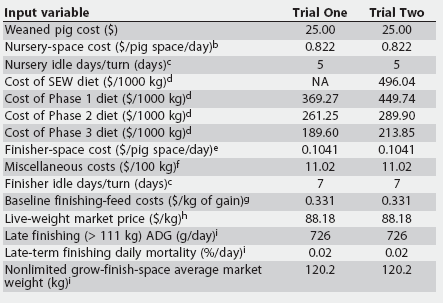
Inputted cost and revenue assumptions (Table 1) were linked with trial data, enabling operationally specific information to be applied to trial data. Linking input assumptions in this manner allows the model user to readily determine the sensitivity of calculated outcomes to a wide range of inputted cost and revenue assumptions. In brief, we assumed a standard weaned-pig cost and cost of pig space (nursery and finishing) to account for labor and facility costs during the growing period. Nursery feed intake, mortality, and space-cost information were coupled with the standardized weaned-pig cost to calculate a feeder-pig transfer cost for each finishing pen. Because feed intake was not measured by pen in the finishing phase, we assessed a baseline feed cost per unit of gain in each finishing pen, ie, finishing pen gain = weight sold - weight at placement in finisher. In an effort to add to the conservative nature of this analysis, the modeled baseline feed cost per unit of gain assessed to each pen was adjusted to account for any influence of finishing placement weight and sale weight on finishing-feed cost per kg of gain. Feed costs per unit of gain were adjusted to a standard 22.6-kg finishing placement and a 113.4-kg sale weight. Feed costs per unit of gain were adjusted by 0.441% for each 1-kg change in placement and sale weight.11 Additionally, a miscellaneous cost per hundredweight was included in our input assumptions to enable the model user the flexibility of including other production costs incurred that are generally static on a cost-per-100- kg-sold basis (eg, transportation, vaccines and drugs, supplies, genetic royalties, overhead, and management fees). Thus, a total wean-to-finish cost calculated for each pen of finishing pigs included feeder-pig costs, finishing-space costs, finishing-feed costs incurred on pen gain observed, and an inputted miscellaneous cost per 100 kg sold. Revenue for each pen was calculated using the total weight sold from each pen and an inputted live-weight market price. All live weight at slaughter was valued equally in our modeling procedures as a conservative and straightforward approach to quantify the differences in revenue between treatments. Nursery mortality data was used both in the feeder-pig cost calculation and to determine how many weaned pigs were required to fill each finishing pen. This enabled wean-to-finish growth and economic performance to be calculated using the weaned pig as the common denominator.
Because availability of grow-finish space in production systems may vary from inadequate to excessive, cost and revenue information were calculated under two different finishing-space scenarios, limited or nonlimited. The limited-finishing-space analysis assumes a restricted finishing capacity, and all age groups are sold a fixed number of days after weaning. Nonlimited finishing capacity allows all age groups to be grown to an equal and predetermined average market weight, as number of post-weaning days to market is not a constraint. To enable the nonlimited-finishing-space analysis, additional inputted assumptions need to be made for late-term finishing (> 156 and > 153 days postweaning in Trials One and Two, respectively) daily growth rate (ADG), daily mortality rate, and desired common market weight. The input assumptions used in this analysis are illustrated in Table 1.
Wean-to-finish performance
Weight sold per pig weaned was determined to evaluate the effects of weaning age on wean-to-finish throughput. Cost and revenue are presented on a per-pig-weaned and per-head-sold basis. Expressing growth and financial performance on a per-pig-weaned basis enables wean-to-finish throughput, costs, and revenue to be quantified in a manner that directly relates to value of the weaned pig.
Statistical analysis
Analysis of variance was used to analyze live and economic performance as a randomized complete block design using the Proc Mixed procedures of SAS version 8.1 (SAS Institute Inc, Cary, North Carolina). In both trials, the statistical model included the fixed effect of weaning age as a class variable and block as a random effect. Polynomial linear and quadratic contrasts of treatment means were used to determine the effects of increasing weaning age. In Trial Two, the model also included the fixed effect of nursery feeding program and the interactive effects of weaning age and nursery feeding program.
Due to the similarities between trials and lack of significant effects (P > .05) of nursery feeding program on wean-to-finish growth performance in Trial Two, data from both trials were pooled for additional modeling. Data from the 15-, 18-, and 21-day treatments in Trial One, and all data (15.5-, 18.5-, and 21.5-day treatments) in Trial Two were fitted into a single mixed model with the fixed effect of weaning age modeled as a linear covariate and including both trial and block as random effects. This single model collectively estimated the linear rate of change (slope) in wean-to-finish biologic and economic performance observed for each day change in weaning age from 15 to 21.5 days. The 12-day treatment data from Trial One was dropped from this singular mixed model so that the range of weaning ages evaluated between the trials was similar. As an alternative frame of reference, the observed rates of change per day increase in weaning age were converted to estimated change per kg increase in weaning weight. However, these estimated changes per kg increase in weaning weight need to be interpreted with the understanding that the incremental increase in weaning weight is due to increasing lactation length. Due to the confounding nature of weaning age and weight in these trials, it is not possible to separate the effects of weaning age and weight. Additionally, a sensitivity analyses of market price and cost of finishing space were conducted on the pooled data from Trials One and Two to illustrate the effects of weaning age on incremental wean-to-finish margin per pig weaned (or weaned-pig value) over a wide range of market prices and finishing-space costs as weaning age increased from 15 to 21.5 days. Pen was the experimental unit in all data analyses.
Results
In Trial One, feeder-pig cost increased (quadratic; Table 2) as weaning age increased due to a linear increase in nursery feed intake with increasing weaning age. Feeder-pig costs increased only for pigs weaned at 21 days, compared to the other weaning-age treatments (Table 2). Feeder- pig costs were similar as weaning age increased from 12 to 21 days because increasing weaning age was associated with lower mortality. In Trial Two, feeder-pig costs increased (linear) as weaning age increased due to linearly increasing nursery feed intake with increasing weaning age (Table 2).
Table 2: Influence of weaning age on postweaning costs and revenue ($US) with limited finishing space a
a Wean-to-finish cost and revenue data from two trials evaluating effects of weaning age in a multi-site production system with limited finishing space. A total of 2272 and 3456 pigs were used in a randomised complete block design with 24 and 40 replications per weaning-age treatment in Trials One and Two, respectively. Limited finishing space is defined as a fixed number of finishing spaces available, therefore analysis assumes that all age groups must be sold a fixed number of days postweaning (ie, by the last day of the trial in this analysis). b Allotment weight = average pig weight attained 3 days prior to weaning. c Feeder-pig weight = average pig weight 42 days postweaning. d Final weight = average pig weight at 156 and 153 days postweaning for Trials One and Two, respectively. e Weight sold/pig weaned = final pen weight weaned pigs required to fill finishing pen. f Feeder-pig cost = standardized weaned-pig cost + all nursery costs. |
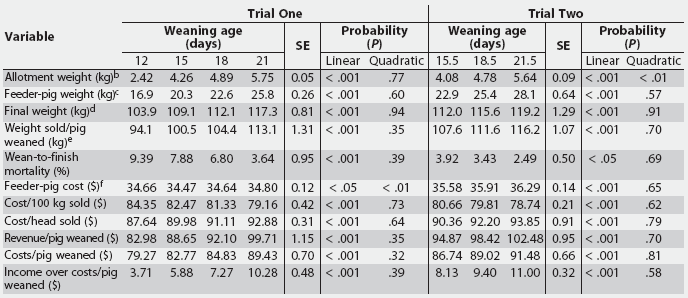
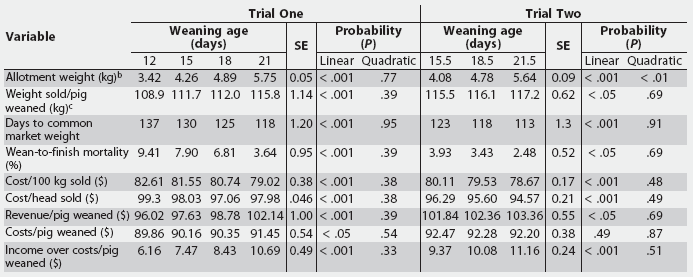
In both trials and finishing-capacity scenarios (limited and nonlimited), weight sold per pig weaned and income over costs (margin) per pig weaned increased (linear; Tables 2 and 3), while wean-to-finish cost per hundredweight decreased (linear) as weaning age increased from 12 to 21 and 15.5 to 21.5 days in Trials One and Two, respectively (Table 2). When finishing capacity was nonlimiting and all age groups could be marketed at an equal average pig weight, wean-to-finish costs per head sold and postweaning days to a common market weight decreased (linear) as weaning age increased (Table 2).
Table 3: Influence of weaning age on cost and revenue ($US) with nonlimited finishing space when pigs are sold at 120.2 kga
a Wean-to-finish cost and revenue data from two trials evaluating effects of weaning age in a multi-site production system with nonlimited finishing space. A total of 2272 and 3456 pigs were used in a randomised complete block design with 24 and 40 replications per weaning age treatment in Trials One and Two, respectively. Nonlimited finishing space is defined as an unlimited number of finishing spaces available, therefore, all groups can be grown to an equal slaughter weight. b Allotment weight = average pig weight attained 3 days prior to weaning. c Weight sold/pig = final pen weight weaned pigs required to fill finishing pen. |
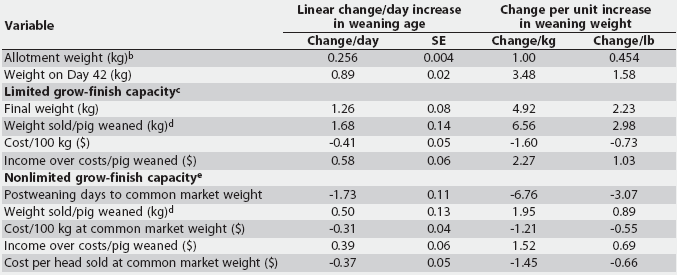
Data from each trial (for 15-, 18-, and 21-day treatments in Trial One and 15.5-, 18.5-, and 21.5-day treatments in Trial Two) were pooled into a single statistical model to collectively estimate the linear effects on measures of postweaning performance when weaning age increased from 15 to 21.5 days. These estimates were calculated for both limited and nonlimited finishing-capacity scenarios (Table 4), and indicate the rate of linear change in postweaning performance measures as weaning age increased from 15 to 21.5 days. For example, these studies predict 42-day postweaning weight will increase by 0.89 +/- 0.02 kg for each day increase in weaning age. These predicted changes due to increasing weaning age were converted to predicted change per kg increase in weaning weight; for example, these studies predict that 42-day postweaning weight would increase by 3.48 kg for each 1-kg increase in weaning weight. However, these weaning-age to weaning-weight conversions are applicable only when weaning-weight increases are due to increasing lactation length within the range of 15 and 21.5 days.
Table 4: Linear rates of change in production costs and revenues as weaning age increases from 15.0 to 21.5 days at $88 per 100 kg ($US) live-weight market price in a multi-site production system when finishing space is either limited or nonlimiteda
a Modeling the rate of linear change (slopes) in wean-to-finish throughput and financial performance observed as weaning age increases. b All pigs weighed 3 days after weaning (Day 0). c Limited finishing space is defined as a fixed number of finishing spaces available, therefore analysis assumes that all age groups must be sold a fixed number of days postweaning (ie, by the last day of the trial in this analysis). d Weight sold/pig = final pen weight weaned pigs required to fill finishing pen. e Nonlimited finishing space is defined as an unlimited number of finishing spaces available, therefore, all groups can be grown to an equal slaughter weight. |
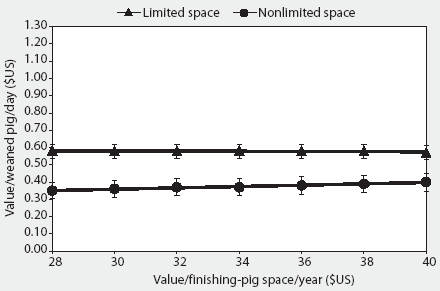
The pooled data from Trial One (15-, 18-, and 21-day treatments) and Trial Two (15.5-, 18.5-, and 21.5-day treatments) were modeled over a wide range of market prices and finishing-space costs. These sensitivity analyses illustrate the effect of weaning age on wean-to-finish margin per pig weaned (or increase in weaned-pig value per day increase in weaning age) over a wide range of market prices (Figure 2) and finishing-space costs (Figure 3). In the limited-finishing-space scenario, the economic effects of weaning age are more sensitive to market price, increasing from $0.39 to $1.13 per pig weaned per day increase in weaning age as market price increases from $77 per 100 kg to $121 per 100 kg. When finishing space is nonlimited, the economic effects of weaning age are less sensitive to market price, increasing only from $0.33 to $0.56 per pig weaned per day increase in weaning age over the same range of market price. The economic effects of weaning age are relatively insensitive to finishing-space costs.
Figure 2: The effects of slaughter price on wean-to-finish margin per pig weaned per day increase in weaning age (15 to 21.5 days of age) were modeled over a wide range of market prices for both limited and nonlimited finishing-space scenarios in a multi-site production system. Limited finishing space indicates that a fixed number of finishing spaces are available and that all age groups must be sold a fixed number of days postweaning, or on the last day of the trial in this analysis. Nonlimited finishing space means an unlimited number of finishing spaces are available, and that all age groups can be marketed at an equal average weight. Trend lines and associated standard errors are illustrated for reference. The regression equations shown (where y = margin/weaned pig/ day increase in weaning age and x = slaughter price in US$/100 kg of live weight) describe how the improvement in margin/weaned pig/day increase in weaning age is affected by increasing live-weight market price.
|
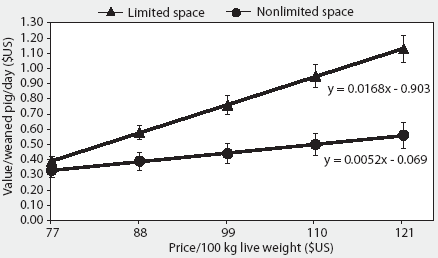
Figure 3: The effects of finishing space costs on wean-to-finish margin per pig weaned per day increase in weaning age (15 to 21.5 days of age) were modeled over a wide range of finishing-space costs for both limited and nonlimited finishing-space scenarios in a multi-site production system. Limited finishing space indicates that a fixed number of finishing spaces are available and that all age groups must be sold a fixed number of days postweaning, or on the last day of the trial in this analysis. Nonlimited finishing space means an unlimited number of finishing spaces are available, and that all age groups can be marketed at an equal average weight.
|
Discussion
The decreased wean-to-finish costs per unit of weight sold and increased margin per pig weaned were driven by the increased weight sold per pig weaned as weaning age increased to 21 and 21.5 days in Trials One and Two, respectively. Weight sold per pig weaned is a function of weaning weight, growth rate, and livability. The growth performance responses observed in these trials, and how they compare to other studies evaluating weaning age, have been previously reported.9 In brief, the observed increase in weight sold per pig weaned was primarily due to linear increases in both growth rate and livability that largely occurred in the initial 42 days postweaning, with an ongoing increase in finishing growth rate. These studies suggest that weaning age plays a primary role in nursery growth performance (Days 0 to 42) achieved for pigs of similar health status and in a similar environment, and that increasing weaning age to 21.5 days may be an effective production strategy to improve wean-to-finish growth performance in a multi-site production system.
The primary difference between the limited and nonlimited finishing-space scenarios is that the value of increasing growth rate is more fully recognized when finishing spaces are limited. This is because the observed increase in weight sold per pig weaned per day increase in weaning age is greater when finishing space is limited than when it is nonlimited. Due to seasonal trends in both finishing growth rates and sow reproductive performance that commonly exist in pig production, production systems may differ seasonally in their finishing-space scenario. For example, a production system may be limited in grow-finish space during July, August, and September as the implications of summer heat on finishing growth rate are realized. However, grow-finish space may be nonlimited in December, January, and February as the effects of accelerated fall growth rates are fully realized and potentially coupled with reduced output from the sow farms due to a dip in summer breeding herd performance. Therefore, the true economic value of weaning age probably lies between the limited and nonlimited space estimates.
Quantifying the effects of weaning age on weaned-pig value demonstrates the need to identify inefficiencies in lactation crate utilization or facility restrictions that may be constraining weaning age. There was a difference of $2.34 (nonlimited finishing space) to $3.48 (limited finishing space) in margin per weaned pig (or weaned-pig value) as weaning age increased from 15 to 21 days. These data indicate that simply assessing a common value to weaned pigs, regardless of age or weight, may lead to incorrect conclusions concerning sow herd productivity or contribution to whole system profitability. Valuing populations of acceptable weaned pigs equally, regardless of age or weight at weaning, fails to account for the substantial differences in wean-to-finish costs and revenue observed in these studies. Accounting for all acceptable weaned pigs equally may also inflate the perceived benefit of increasing breeding and gestation inventories without regard for lactation-space availability. These two trials estimate that weaned-pig value increases $0.39 (nonlimited space) to $0.58 (limited finishing space) for each day increase in weaning age in a multi-site production system.
Once producers understand the effect that weaning age has on wean-to-finish costs and revenue, they can use partial-budgeting techniques to evaluate the cost-benefit relationships of altering weaning age. Partial budgeting is a well-described tool used to illustrate the net effect of altering individual management strategies on whole system cost and revenue.12-14 Partial budgeting is an effective means of weighing the costs against the benefits associated with increasing weaning age. Weaning age can be increased by improving efficiency in use of lactation space, adding lactation space, decreasing the number of sows that farrow each week, or by some combination of these methods. Costs and benefits of each option can be readily modeled to estimate the net impact of the option.
The effects of weaning age were converted to a per kg change in weaning weight for bench-marking purposes. These weaning weight predictions need to be interpreted with caution by assuming that the incremental increase in weaning weight is due to an increase in weaning age. In contrast, using the results of our study to evaluate the economic impact of increases in weaning weight without alteration in weaning age would be inappropriate. For example, Wolter et al15 found that increasing weaning weight by feeding supplemental milk replacer during lactation had no effect on growth rate, whether it was calculated from weaning at 21 days to a weight of 14 kg, or from weaning to market weight (110 kg). However, pigs supplemented with milk throughout the 21-day suckling period required fewer days to reach 110 kg.15 As the effects of supplemental milk replacer on subsequent growth performance reported by Wolter et al15 do not parallel the results of our weaning age studies, it is possible that not all alternative strategies to increase weaning weight have the same effect on postweaning growth performance.
The effect of weaning age on margin per pig weaned (or weaned-pig value) is positively correlated with market price, because the value of the incremental increase in weight sold per pig weaned increases with increasing market price while costs remain unchanged. Market price has a greater effect on margin per weaned-pig (or weaned-pig value) when finishing space is limiting: in this study, there was a $0.0168 and $0.005 increase per weaned pig per day increase in weaning age for each $1 per 100-kg increase in live-weight market price in limited and nonlimited finishing-space scenarios, respectively. This is because the increases in weight sold per pig weaned are greater when finishing space is limited than when it is nonlimited. Finishing-space costs do not greatly affect the magnitude of the incremental value of weaning age. However, in the nonlimited finishing scenario, the incremental value of weaning age modestly increased from $0.35 to $0.40 +/- 0.06 per weaned pig per day change in weaning age as finishing space costs increased from $28 to $40 per pig space. This modest increase was due to the cost savings associated with fewer days to a common market weight as weaning age is increased.
A shortcoming of these studies was our inability to measure pen feed intake during the finishing phase of this study. Therefore, we adjusted the modeled baseline feed cost per unit of gain to a common finishing placement and sale weight. This removes any potential for bias due to differing finishing placement weights between treatments and differing slaughter weights in the limited-space analysis. Otherwise, there is a potential bias to favor pigs heavier at placement and slaughter (ie, because feed efficiency increases linearly with body weight). However, this weight-influenced bias is minimized by the improvement in finishing growth rate, resulting in less energy being required for maintenance.9 Additionally, there was no consistent effect of weaning age on carcass composition in these studies.16 Therefore, we feel using a weight-adjusted finishing-feed cost per kg of gain to estimate finishing-feed cost is a very conservative assumption that contributes to the overall conservative nature of this analysis. It is also important to note that even though wide changes in ingredient costs have dramatic effects on overall production costs and profitability, these changes in feed price have little impact on the cost or benefit of practices that do not affect feed efficiency.
It should be recognized that the magnitude of difference in wean-to-finish growth and economic performance observed due to increasing weaning age in these studies may vary among multi-site production systems. Differing conditions, such as health status, environment, operational-dependent cost structure, and genetic line, would influence the magnitude of the growth and economic response to increasing weaning age. However, the general trend in biological performance is expected to be similar across different systems.
These studies illustrate the economic effects of weaning age on weaned-pig value in a commercial multi-site production system. When evaluating potential shifts in weaning age within a production operation, it is likely important to understand the endemic pathogens present in the system, and which of these pathogens are being eliminated or controlled by current weaning strategies.7,8 It has been suggested that both age and variation in weaning age play a role in the health improvements associated with segregated pig production.8 Therefore, if mean weaning age is increased, controlling pig movement during lactation and understanding pig age variation at weaning is of utmost importance. Improving lactation- crate utilization, decreasing week-to-week variability in the number of sows farrowed, altering weekly farrowing targets, and increasing lactation capacity are the primary means of increasing and maintaining consistency in weaning age.
Implications
- Under the conditions of these studies in a multi-site production system, wean-to-finish costs per unit of weight sold decrease and margin per pig weaned increase as weaning age increases to 21.5 days.
- Under the conditions of these studies, linear increases in postweaning growth rate and livability are the biological drivers of the observed economic advantages of increasing weaning age to 21.5 days.
- Under the conditions of these studies, increasing weaning age from 15 to 21.5 days increases the value of weaned pigs to a greater degree when finishing capacity is limited than when it is nonlimited.
- The estimated rate of change in weaned pig value due to increasing weaning age from 15 to 21.5 days of age increases with market price, but is not greatly affected over a wide range of finishing-space costs.
- Assessing a common value to weaned pigs in a multi-site production system regardless of age or weight may lead to incorrect conclusions concerning a sow herd's contribution to whole- system profitability.
Acknowledgement
Contribution no. 04-042-J from the Kansas Agricultural Experiment Station, Manhattan, KS 66506.
References
*1. DiPietre DD, Tubbs R. Valuing weaned pigs through budgeting process. Proc AASP. 1992;222-226.
*2. Brumm M, Bittney L. Pricing SEW piglets. NebFacts NF95-224. Lincoln, Nebraska: University of Nebraska; 1995.
*3. Dhuyvetter KC. Estimating the value of segregated early weaned pigs. Cooperative Extension Service Publication MF-2221. Manhattan, Kansas: Kansas State University; 1996.
*4. Meyer SR, Lazarus B. How can we price early weaned pigs. National Pork Producers Council; 1997.
*5. Leman AD. Optimizing farrowing rate and litter size and minimizing nonproductive sow days. Vet Clin North Am Food Anim Pract. 1992;8:609-621.
6. Harris DL. Alternative approaches to eliminating diseases and improving performance of pigs. Vet Rec. 1988;123:422-423.
7. Harris DL, Alexander TJ. Methods of disease control. In: Straw BE, D'Allaire S, Mengling WL, Taylor DJ, eds. Diseases of Swine. 8th ed. Ames, Iowa: Iowa State University Press; 1999:1077-1110.
8. Harris DL. Multi-site pig production. Ames, Iowa: Iowa State University Press; 2000.
9. Main RG, Dritz SS, Tokach MD, Goodband RD, Nelssen JL. Increasing weaning age improves pig performance in a multi-site production system. J Anim Sci. 2004;82:1499-1507.
10. FASS. Guide for the Care and Use of Agricultural Animals in Agricultural Research and Teaching. 1st rev ed. Savoy, Illinois: Federation of Animal Science Societies; 1999.
*11. Dritz SS, Tokach MD, Goodband RD, Nelssen JL. Growing-Finishing Pig Recommendations. Kansas State University Research and Extension Publication MF-2301. 1997. Available at: http://www.oznet.ksu.edu/library/lvstk2/mf2301.pdf. Accessed May 3, 2005.
12. Wittum TE, Dewey CE. Partial budget analysis of sow Escherichia coli vaccination. Swine Health Prod. 1996;4:9-13.
13. Lane DM, Rendleman CM, Ott SL. Using partial budgets to analyze select management practices associated with reduced pre-weaning mortality. Swine Health Prod. 1997;53:95-102.
14. Drum SD, Marsh WE. How to use partial budgets to predict the impact of implementing segregated early weaning in a swine herd. Swine Health Prod. 1999;71:13-18.
15. Wolter BF, Ellis M, Corrigan BP, DeDecker JM. The effect of birth weight and feeding supplemental milk replacer to piglets during lactation on preweaning and postweaning growth performance and carcass characteristics. J Anim Sci. 2002;80:301-308.
*16. Main RG, Dritz SS, Tokach MD, Goodband RD, Nelssen JL. Effects of weaning age on pig performance in three-site-production. KSU Swine Day Extension Publication. Manhattan, Kansas: Kansas State University; 2002.
* Non-refereed references.