
What's your interpretation? |
Non refereed |
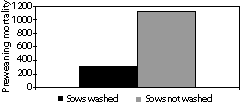 The graph represents preweaning deaths caused by neonatal diarrhea in 22 sow
herds during a calendar year. Herds were categorized as those that either washed
sows (nine herds, total 25,050 sows) or did not wash sows (13 herds, 27,525
sows) before they were loaded into the farrowing crates. What impact might
this management practice have on preweaning mortality? What other data might
be collected in these herds to support or discourage the practice of washing
sows before loading?
The graph represents preweaning deaths caused by neonatal diarrhea in 22 sow
herds during a calendar year. Herds were categorized as those that either washed
sows (nine herds, total 25,050 sows) or did not wash sows (13 herds, 27,525
sows) before they were loaded into the farrowing crates. What impact might
this management practice have on preweaning mortality? What other data might
be collected in these herds to support or discourage the practice of washing
sows before loading?
To wash or not to wash?
Tara Donovan, DVM
E 4614 Highway 14-60, Spring Green, WI 53588; Tel: 608-588-9170.
Cite as: Donovan T. To wash or not to wash? J Swine Health Prod. 2003;11(5):266-267.
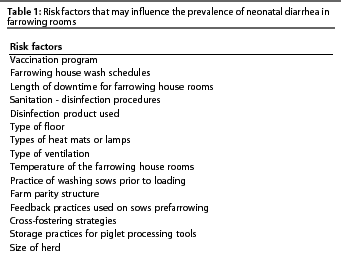
Outbreaks of neonatal diarrhea in farrowing houses are common among swine production units. After a recent outbreak in one production unit, there was a challenge to understand what differences among management practices at the farms may predispose piglets to diarrhea. Table 1 lists some potential risk factors that may influence the prevalence of neonatal diarrhea in the farrowing house. Programs and processes were compared among 22 sow herds in this production system. Two important factors that predispose piglets to neonatal diarrhea are inadequate piglet immunity and poor sanitation. With this in mind, the practice of washing sows prior to loading them into the farrowing crates was identified as a difference among the herds, considering the overall inconsistency of the practice. As sow washing was not universally accepted, supporting information was sought to help determine the value of the time and effort required to wash sows.
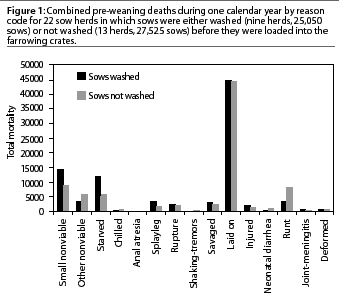
The 22 sow herds were divided into two groups: those that washed sows (nine herds, total 25,050 sows) and those that did not wash sows (13 herds, total 27,525 sows). The preweaning mortality data for each group of sows for a full calendar year are presented in Figure 1. Although neonatal diarrhea is not a primary cause of death, there was a tendency towards more deaths reported due to neonatal diarrhea from the "do not wash" category. In the "wash" herds, 0.34% of deaths were recorded as due to neonatal diarrhea, and in the "do not wash" herds, 1.36% of deaths were due to neonatal diarrhea, for a difference of 1% more deaths (814 pigs that were lost) in the herds that did not wash sows.
In this production system, morbidity is usually high and mortality low during outbreaks of diarrhea. Common diagnoses are Escherichia coli, Clostridium perfringens, Clostridium difficile, and rotavirus. Since the incidence of neonatal diarrhea was not recorded, it was impossible to determine overall piglet morbidity. However, supporting information was available to estimate morbidity. Whenever a new outbreak of neonatal diarrhea occurred in these herds, the established protocol was to submit affected pigs for an antibiotic sensitivity pattern. Even if the clinical signs were similar to any previous outbreak, tissues of affected pigs were submitted.
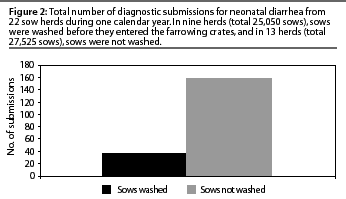
The diagnostic submissions from these herds are depicted in Figure 2. It is evident that fewer diagnostic laboratory submissions for diarrhea work-ups came from herds that washed sows (35 submissions) compared to herds that did not wash sows (156 submissions). Figure 3 depicts submissions from these herds individually. Another data set that would have been useful for determining the incidence of neonatal diarrhea is the number of piglets treated for neonatal diarrhea. Unfortunately, this information was impossible to combine and analyze for all herds, since each farm has a different treatment record system.
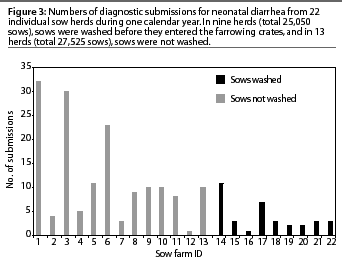
Thus, on the basis of the general differences among nonspecific data collected in this group of herds, it appears that washing sows is beneficial. A controlled study would be ideal to evaluate the effect of washing sows prior to loading into farrowing crates.